Ruby
 Golang
 .Net
 MCP
 C++

Keeping track of stock performance across dozens or even hundreds of companies can quickly become overwhelming. Instead of manually checking financial websites throughout the day, you can build a dashboard that automatically gathers stock prices, company news, analyst ratings, and market trends in one place.
In this tutorial, we'll build a stock monitoring dashboard using SerpApi's Google Finance API, Google News API, and Google Trends API.
If you are new to SerpApi, get setup before diving in, using this blog post:
 Hilman Ramadhan
Getting Setup
Before we get started with the code, let's make sure everything is installed and set up.
Install Packages
For this example we will need to install relevant packages if you don't have them already including:
requests: Query SerpApi using a query link.python-dotenv: Store and access your API key in a .env filepandas: Organize and manipulate returned datastreamlit: Display the data on a dasbhoard
You can install all 4 at once using this command:
pip install requests python-dotenv pandas streamlitNow that all required packages are installed let's move into the code.
.env File
If you're not sure how to store your API key in a .env file, get started with this blog post:
 Corbin Davenport
Code Step By Step
Now let's jump into the code, you should have a Python project file setup.
Import Packages
First we'll import the applicable packages in our code in order to access them. os, zoneinfo, and datetime are included in Python's standard library and do not need to be installed separately.
import requests
import os
import streamlit as st
import pandas as pd
from dotenv import load_dotenv
from datetime import datetime
from zoneinfo import ZoneInfo
Get Finance Results for a Watchlist
We will be using the Google Finance API to track specific tickers, including their title, prices, and movement.
- Set watchlist dictionary of arrays
This should contain the company tickers you want to track with the value set as an array to store the values we collect.
watchlist = {"AAPL":[], "MSFT":[], "GOOGL":[], "NVDA":[], "AMZN":[]}- Define a function:
Input parameter: watchlist dictionary to read and add the values from the results
def get_watchlist_finance(watchlist):- Set unchanging parameters
In this example, for every Google Finance API query, these parameters will be the same for every query:
-
engine: Search engine you want to query. For the Google Finance API, find it here. api_key: Your secret API key. Find it here.json_restrictor: Not required but in this example we'll only be accessing the data in thesummarysection of the results. See more here.
params = {
      "engine": "google_finance",
      "api_key": API_KEY,
      "json_restrictor":"summary"
}- Query SerpApi for Watchlist
Iterate through each key from the watchlist and set the q parameter to the key. Then query the SerpApi endpoint using requests and the input parameters.
  for key in watchlist:
      params["q"] = f"{key}:NASDAQ"
results = requests.get("https://serpapi.com/search.json", params=params).json()["summary"]- Extract & Assign Result Values
Extract the title and price from the results. As well as the price_movement including the direction. If the direction is down set the value to negative.
Append all the values to the ticker key array list for our use later.
watchlist[key].append(results["title"])
watchlist[key].append(results["price"])

price_movement = results["price_movement"]["value"]
price_dir = results["price_movement"]["movement"]
if "Down" in price_dir:
    price_movement *= -1
watchlist[key].append(price_movement)- Query Google Trends
Lastly we will send our list to the get_trends function to add on trend ranking data for each watchlist ticker.
get_trends(watchlist)Get Emerging Companies
We will be using the Google News API find companies that have been emerging in the news and may be up and coming. As well as the Google AI Mode API, in order to identify the company name from the news.
- Set empty
companiesdictionary
As we are looking for companies, this should be an empty dictionary until we extract additional data.
companies = {}- Define a function:
Input parameter: companies empty dictionary to add the companies and their data to.
def get_emerging_companies(companies):- Query SerpApi for News Results
In this example, we will only be querying the Google News API once for results, using these parameters:
-
engine: Search engine you want to query. For the Google News API, find it here. api_key: Your secret API key. Find it here.q: Term used to populate emerging companies in news results. In this case "emerging companies".
Query the SerpApi endpoint using requests and the input parameters.
params = {
      "engine": "google_news",
      "api_key": API_KEY,
      "q": "emerging companies",
  }

results = requests.get("https://serpapi.com/search.json", params=params).json()
- Extract Relevant Data
Extract the article title and link.
for result in news_results["news_results"]:
    title = result["title"]
link = result["link"]- Query SerpApi Google AI Mode
We also would like the company name which can be difficult to extract from the Article title. Query the Google AI Mode API and collect the company name from the article title.
params = {
    "engine": "google_ai_mode",
    "api_key": API_KEY,
    "q": f"Provide the company from this title on the first line and only that, if a company title is not available then just print \"None\": {title}"
}
results = requests.get("https://serpapi.com/search.json", params=params).json()- Assign Result Values
If Google AI Mode provided results, assign the name to the value on the first line of the text_block / snippet.
Set the dictionary key of name to an empty list. Then append the HTML for the link and title of the article.
if "text_blocks" in results:
  name = results["text_blocks"][0]["snippet"].split('\n')[0].replace(',', '')
  if "None" not in name:
      companies[name]=[]
      companies[name].append(f'<a href="{link}" target="_blank">{title}</a>')
- Exit Loop
We are only looking for the first 5 companies so once the list is at 5, break out of the iteration of news results.
if len(companies)>=5:
break- Query Google Trends
Lastly we will send our list to the get_trends function to add on trend ranking data for each emerging company.
get_trends(companies)Get Trending Data
We will be using the Google Trends API to track trend ranking for our watchlist as well as our emerging companies.
- Define a function:
Input parameter: input_list dictionary of either the watchlist or companies.
def get_trends(input_list):- Query SerpApi for Trends Results
In this example, we will only be querying the Google Trends API once for results, using these parameters:
-
engine: Search engine you want to query. For the Google Trends API, find it here. api_key: Your secret API key. Find it here.q: Specify up to 5 terms to compare, separated by a comma.- NOTE: In this case I joined the input list by commas, however if your dicts have over 5 terms you will need to separate these out into separate queries.
date: Set the time range you want to see results for. See more here.
Query the SerpApi endpoint using requests and the input parameters.
params = {
        "engine": "google_trends",
        "api_key": API_KEY,
        "q": ",".join(input_list.keys()),
        "date": "now 1-d"
    }

results = requests.get("https://serpapi.com/search.json", params=params).json()- Extract & Append Relevant Data
Extract each term's average interest over time and append it to the list associated with the corresponding key in input_list (watchlist or companies)
for result in results["interest_over_time"]["averages"]:
    query = result["query"]
    input_list[query].append(result["value"])
Setup Streamlit Dashboard
Now let's setup Streamlit to display the data we collected.
- Define a function:
Input: watchlist and companies to extract the completed data.
def setup_streamlit(watchlist, companies):- Collect the Date / Time
Using datetime, identify the current date, hour, minute for ET.
et_now = datetime.now(ZoneInfo("America/New_York"))
date = f"{et_now.date()} {et_now.hour}:{et_now.minute}ET"- Set the Title
Set the site title plus the date on a newline.
st.title(f'Stocks Dashboard \n{date}')- Set Watchlist
Write the title for "Watchlist" and query the display_table function including the column labels.
st.write("Watchlist")
display_table(watchlist, ["Name", "Price", "Price Movement", "Trend Score"], 3, "Ticker")- Set Companies
Write the title for "Emerging Companies" and query the display_table function including the column labels.
st.write("Emerging Companies")
display_table(companies, ["Article", "Trend Score"], 1, "Name", render_html=True)
Setup a Streamlit Table for Each Dataset
- Define a function:
Inputs: input_list (watchlist or companies), labels (column labels), trend_index (index of trend value for sorting), index_name (key / index), render_html (for the hyperlink for companies).
def display_table(input_list, labels, trend_index, index_name, render_html=False):- Sort Items
Sort items by highest -> lowest using the Trends ranking and input index of the trends list.
sorted_items = sorted(
    input_list.items(),
    key=lambda item: item[1][trend_index] if len(item[1]) > trend_index else -1,
    reverse=True
)- Setup Data for a Table
Iterate through pairs in the sorted list. Assign row data to rows and setup labels then set up a DataFrame.
rows = []
for key, values in sorted_items:
    row = {index_name: key}
    for label, value in zip(labels, values):
        row[label] = value
    rows.append(row)

df = pd.DataFrame(rows)- Send Data to Streamlit
If input parameter render_html is true (companies) use markdown in order for the hyperlink to work.
Otherwise set index_name and send the DataFrame.
if render_html:
    st.markdown(df.to_html(escape=False, index=False, justify="left"), unsafe_allow_html=True)
else:
    df = df.set_index(index_name)
    st.dataframe(df, width="stretch")
Set up Main
Ensure you have main setup to initialize the dictionaries and query the functions we have set up.
def main():
	watchlist = {"AAPL":[], "MSFT":[], "GOOGL":[], "NVDA":[], "AMZN":[]}
	get_watchlist_finance(watchlist)

	companies = {}
	get_emerging_companies(companies)

	setup_streamlit(watchlist, companies)

if __name__ == "__main__":
	main()
Run the Program
To run the program including Streamlit, you must use this command:
program_name streamlit run stocks.pyMake sure to replace "program_name" with your programs actual name, i.e main.py.
Full Code
See the full Python code below.
import requests
import os
import streamlit as st
import pandas as pd
from dotenv import load_dotenv
from datetime import datetime
from zoneinfo import ZoneInfo


load_dotenv()
API_KEY = os.getenv("API_KEY")

# Use SerpApi's Google Finance API to check the each ticker in our watchlist
def get_watchlist_finance(watchlist):

	# Set parameters for the query, including the engine, API key, and JSON restrictor which will stay constant for all tickers
	params = {
		"engine": "google_finance",
		"api_key": API_KEY,
		"json_restrictor":"summary"
	}

	# Iterate through each ticker in the watchlist
	for key in watchlist:

		# Set the query parameter for the current ticker and query SerpApi
		params["q"] = f"{key}:NASDAQ"
		results = requests.get("https://serpapi.com/search.json", params=params).json()["summary"]

		# Append the title and price to the watchlist for the current ticker
		watchlist[key].append(results["title"])
		watchlist[key].append(results["price"])

		# Append the price movement to the watchlist for the current ticker, setting negative if the direction is down
		price_movement = results["price_movement"]["value"]
		price_dir = results["price_movement"]["movement"]
		if "Down" in price_dir:
			price_movement *= -1
		watchlist[key].append(price_movement)

	# Query the get_trends method to collect trends data for the tickers
	get_trends(watchlist)

# Use SerpApi's Google News API to find stories regarding emerging companies then extract the title using the Google AI Mode API
def get_emerging_companies(companies):
	# Set parameters and query the Google News API
	params = {
		"engine": "google_news",
		"api_key": API_KEY,
		"q": "emerging companies",
	}

	news_results = requests.get("https://serpapi.com/search.json", params=params).json()

	# Iterate through each news result to collect the title and link
	for result in news_results["news_results"]:
		title = result["title"]
		link = result["link"]

		# Query the Google AI Mode API to extract the company name from the news title
		params = {
			"engine": "google_ai_mode",
			"api_key": API_KEY,
			"q": f"Provide the company from this title on the first line and only that, if a company title is not available then just print \"None\": {title}"
		}
		results = requests.get("https://serpapi.com/search.json", params=params).json()

		# check if the results contain text blocks and extract the company name
		if "text_blocks" in results:
			name = results["text_blocks"][0]["snippet"].split('\n')[0].replace(',', '')
			if "None" not in name:
				# Set the key to the company name with an array to hold its data, append HTML title and link
				companies[name]=[]
				companies[name].append(f'<a href="{link}" target="_blank">{title}</a>')

		# If the companies list has reached 5, stop collecting more companies
		if len(companies)>=5:
			break

	# Query the get_trends method to collect trends data for the companies
	get_trends(companies)

# Query Google Trends for the given list of tickers or companies and append the trend data to the input list
def get_trends(input_list):
	# Set parameters and query the Google Trends API
	params = {
			"engine": "google_trends",
			"api_key": API_KEY,
			"q": ",".join(input_list.keys()),
			"date": "now 1-d"
		}
	results = requests.get("https://serpapi.com/search.json", params=params).json()

	# Iterate through each trend result and append the trend value to the corresponding company or ticker in the input list
	for result in results["interest_over_time"]["averages"]:
		query = result["query"]
		input_list[query].append(result["value"])

# Display the table on Streamlit including formatting, HTML rendering, and sorting by trend score
def display_table(input_list, labels, trend_index, index_name, render_html=False):

	sorted_items = sorted(
		input_list.items(),
		key=lambda item: item[1][trend_index] if len(item[1]) > trend_index else -1,
		reverse=True
	)

	rows = []
	for key, values in sorted_items:
		row = {index_name: key}
		for label, value in zip(labels, values):
			row[label] = value
		rows.append(row)

	df = pd.DataFrame(rows)

	if render_html:
		st.markdown(df.to_html(escape=False, index=False, justify="left"), unsafe_allow_html=True)
	else:
		df = df.set_index(index_name)
		st.dataframe(df, width="stretch")

# Set up the Streamlit dashboard with the titles, date, and query streamlit helper
def setup_streamlit(watchlist, companies):
	et_now = datetime.now(ZoneInfo("America/New_York"))
	date = f"{et_now.date()} {et_now.hour}:{et_now.minute}ET"

	st.title(f'Stocks Dashboard \n{date}')

	st.write("Watchlist")
	display_table(watchlist, ["Name", "Price", "Price Movement", "Trend Score"], 3, "Ticker")

	st.write("Emerging Companies")
	display_table(companies, ["Article", "Trend Score"], 1, "Name", render_html=True)

def main():
	watchlist = {"AAPL":[], "MSFT":[], "GOOGL":[], "NVDA":[], "AMZN":[]}
	get_watchlist_finance(watchlist)

	companies = {}
	get_emerging_companies(companies)

	setup_streamlit(watchlist, companies)

if __name__ == "__main__":
	main()
Results / Dashboard
Here's the finished dashboard, where you can monitor stock prices, price movements, and trending data for the stocks you're keeping an eye on. You can also explore company news and emerging trends to help spot developments and shifts in interest.
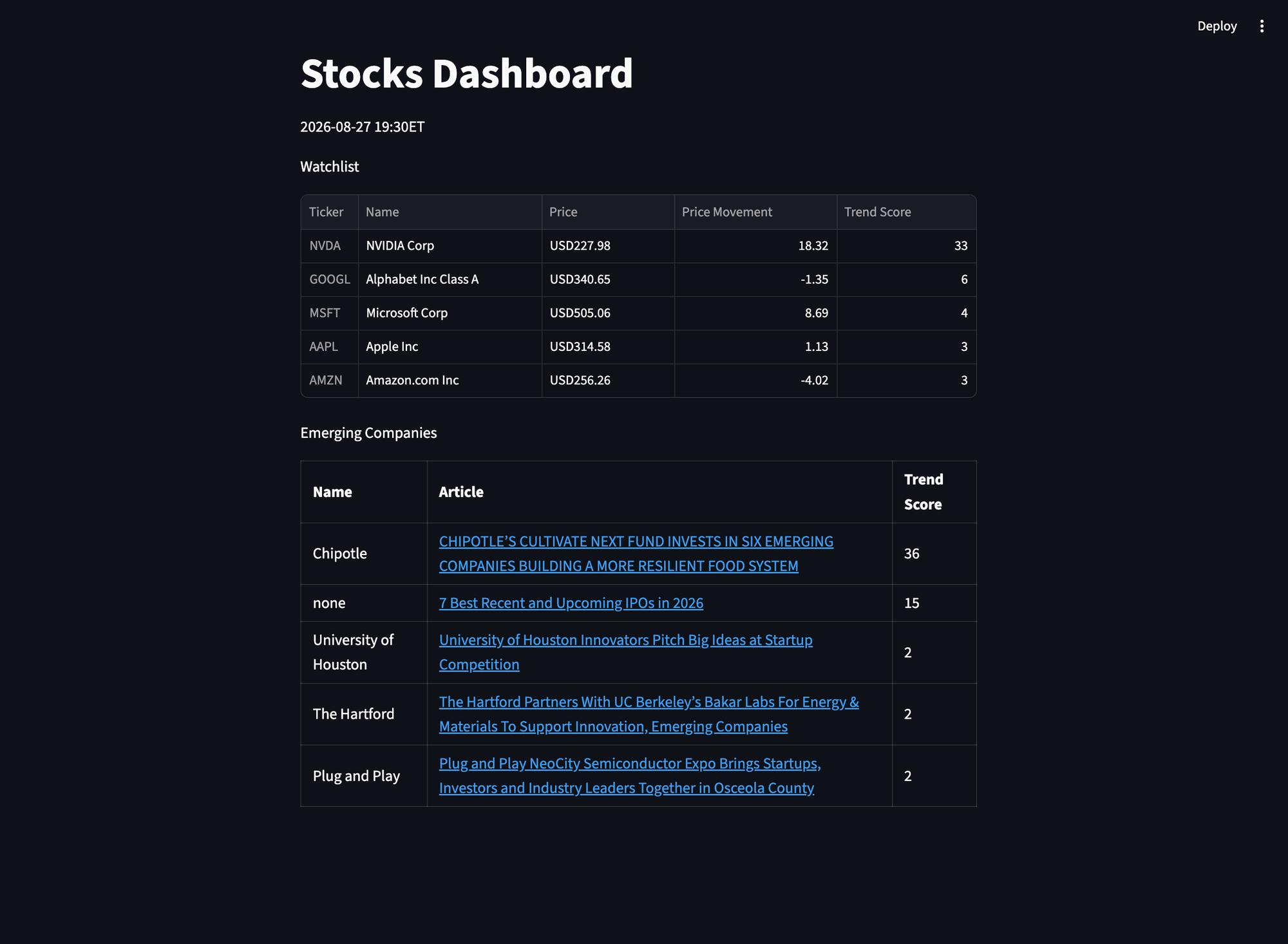
While this dashboard is a simple example of what's possible with SerpApi, there's much more data you can put to work. Google Finance provides additional valuable insights we haven't even used here, including market details, historical price movements, and additional stock recommendations.
You can also take things further by regularly checking so the dashboard is real time and setting up automated alerts through tools like Slack or email. Imagine getting notified when a stock experiences a significant price movement, a company starts trending, or important news breaks. You can turn a simple dashboard into a much more powerful, automated monitoring tool tailored to your needs.
Conclusion
You've now built a stock dashboard powered by real-time insights from SerpApi's Google Finance API, Google Trends API, Google News API, and Google AI Mode API.
And this is just one example of what's possible! There's so much more data to explore across these APIs and the many other APIs SerpApi supports. Whether you're building dashboards, tracking market trends, or creating entirely new applications, the possibilities are endless.
Haven't signed up yet? Get started for free with 250 successful searches per month: https://serpapi.com/users/sign_up
Explore the rest of our APIs here: https://serpapi.com/search-engine-apis
Need a hand along the way? Reach out to us via chat or email at contact@serpapi.com. We're always happy to help!
Related Blogs
- Web scraping stock prices in Python
- Web Scraping Google Finance Main Page in Python
- Scrape Google Finance Markets in Python
- Scrape Google Finance Ticker Quote Data in Python
- How to scrape Google Trends
- Trend Prediction for Emerging Products using Python
- Scraping Google news using Python (2026 Tutorial)
- How to Build a Brand Monitoring Dashboard with SerpApi and Python