









 Ruby
Ruby
 Golang
 .Net
.Net
 MCP
MCP
 C++
C++

Over the past several years Google Search had one of the biggest transformations in its history. Now it does way more than just rank pages. AI Overviews, AI Mode, generated interfaces, and search agents are changing what happens after a query is submitted.
Three years ago, Google's generative search was an experiment behind a waitlist. By the middle of 2026, AI Overviews reached more than 2.5 billion monthly users. Google was also adding generated layouts, live conversations, planning tools, and agents to Search. The familiar list of links remains, but it now sits inside a larger product that can research a question, organize the results, and sometimes complete the next step.
A summary above the results is only part of the change. The search engine results page, or SERP, is becoming an interface shaped by the query and by what Google thinks the user wants to do next.
The answer moved above the links
Google first showed its Search Generative Experience in May 2023. A year later, it renamed the feature AI Overviews and began rolling it out to all users in the United States. By October 2024, AI Overviews had expanded to more than 100 countries and passed one billion monthly users.
The scale has continued to grow. In a June 2026 investor presentation, Google reported more than 2.5 billion monthly users for AI Overviews.
AI Overviews did not replace the rest of the page. They became another surface alongside organic results, videos, discussions, shopping results, local listings, and related questions. But they changed the order of attention. For many informational searches, the generated answer is now the first result a person reads.
Google also builds that answer differently from a conventional ranked result. Google Search Central explains that AI Overviews and AI Mode can use query fan-out, issuing several related searches across subtopics and data sources before composing a response. The result may draw on a much broader retrieval process than the ten links visible on the page.
A query became a conversation
AI Overviews still belong to the traditional SERP. They answer one query and leave the rest of the page in place. AI Mode, introduced in March 2025 and rolled out across the United States that May, goes further.
AI Mode treats search as a continuing session. People can ask follow-up questions, add images or files, and refine the task without beginning again. Search Live extended that interaction to real-time voice and video, while Personal Intelligence began using information from connected Google services to tailor answers.
Deep Search pushes the same model toward longer research. Google says it can issue hundreds of searches, reason across separate pieces of information, and produce a cited report within minutes.
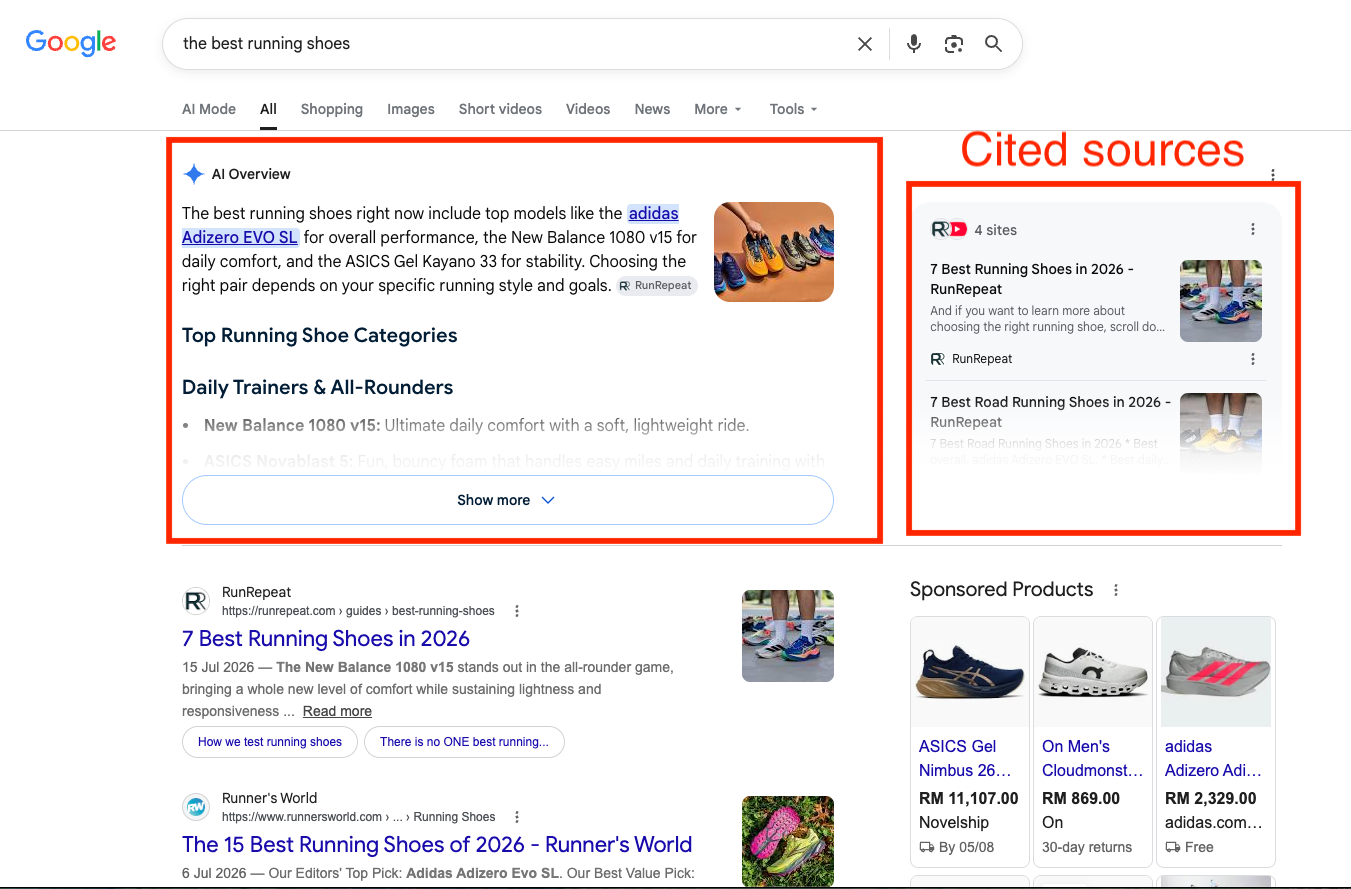
The result looks different in practice. During our research, we ran the same query, "the best running shoes" through Google Search and Google AI Mode. The standard SERP returned an AI Overview, 8 organic results, four related questions, videos, discussions, and other familiar modules. AI Mode returned a composed answer with an opening recommendation, a categorized breakdown with product cards showing prices and ratings, and citations drawn from 16 sites.
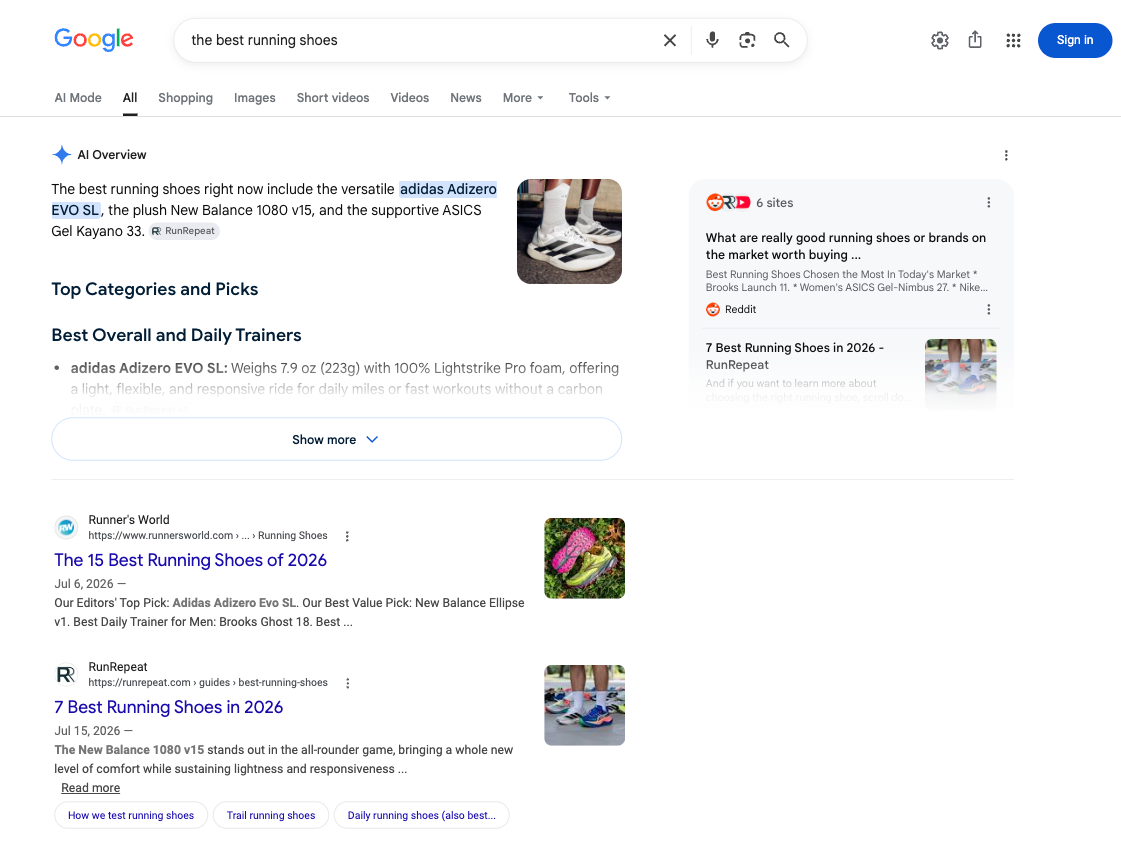
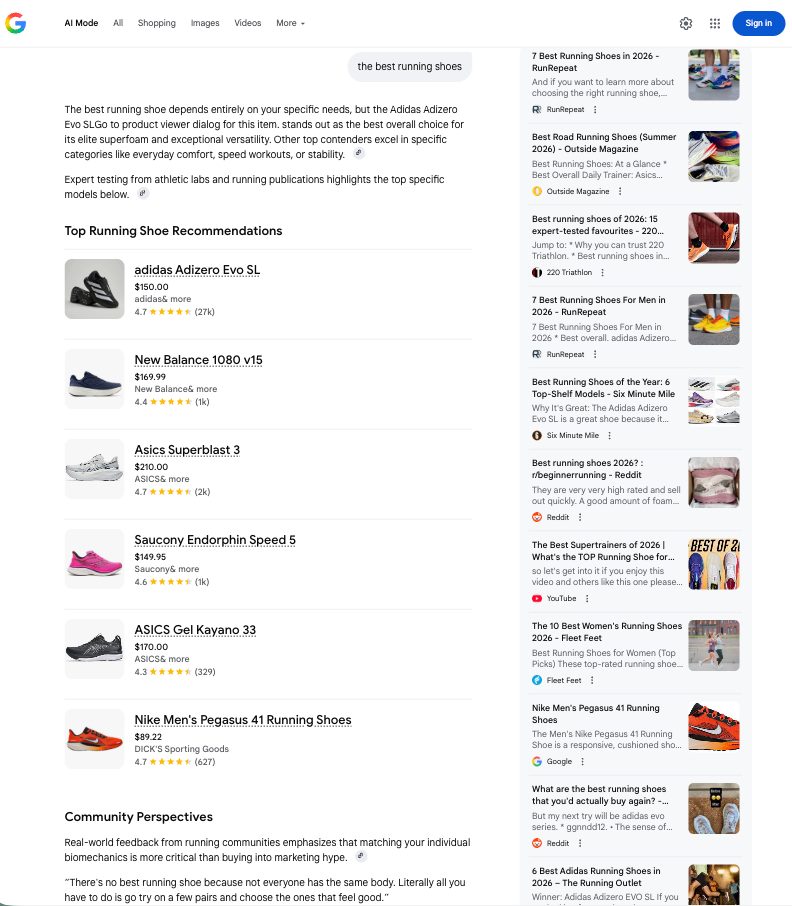
One example does not measure the whole product, but it illustrates the difference between the two surfaces. The standard SERP arranges a collection of result modules, while AI Mode builds a researched answer.
The page itself is becoming generated
Google has also tested what happens when AI organizes the links rather than summarizing them. Web Guide, a Search Labs experiment introduced in 2025, groups results into AI-generated categories based on different parts of a query.
AI Mode has moved in the same direction. Gemini 3 introduced generated visual layouts, interactive tools, and simulations, allowing the response format to change with the question. A financial comparison might receive a chart, while a technical question might receive a calculator or another interactive component.
Canvas turns the results page into a workspace that persists beyond one answer. It can organize research, build a travel plan, draft a document, or create a small interactive tool. Search Live allows the same system to respond to what a camera sees in real time.
Availability still varies, and some of these features began as Labs tests or limited rollouts. Together, they point toward results pages whose layouts adapt to each query.
Search is starting to act
Google is going beyond presentation and turning parts of Search into an agent that can take action across other websites.
AI Mode began with tasks such as finding restaurant reservations, local appointments, and event tickets that match a detailed request. Its travel-planning features bring flights, hotels, Maps data, and saved places together inside Canvas.
Commerce is moving closer to completion as well. Google introduced the Universal Commerce Protocol in early 2026 and said it would support checkout from eligible product listings in AI Mode and Gemini. A user could search for a product, compare stores, and complete more of the purchase without leaving the AI interface.
Most queries still end with information or a destination, but the boundary between discovering an option and acting on it is becoming less clear.
The open web still supplies the answer
All of these systems depend on the web beneath them. AI Overviews cite pages, AI Mode displays references, and query fan-out relies on Google finding and retrieving relevant material. Google says there are no separate technical requirements for appearing in its AI features beyond normal Search eligibility and sound SEO practice. What remains unsettled is how much traffic returns to those sources.
Google says AI features encourage more searches and produce better visits. It reported that AI Overviews increased usage by more than 10% for relevant query types in the United States and India. The company also says it continues to send billions of clicks to the web each day and that people who follow links from AI results tend to spend more time on the sites they visit.
Independent research has found a clear reduction in click-through volume. Pew Research Center found that people clicked a conventional result on 8% of visits when an AI summary appeared, compared with 15% when it did not. Only 1% clicked a source link inside the summary. An Ahrefs study using a different methodology estimated that an AI Overview reduced clicks to the top-ranking page by 58%.
These findings do not necessarily contradict Google's claims. More searches and better-qualified visits can coexist with fewer clicks per search. For publishers, the distinction matters: visibility inside an answer does not guarantee traffic from it.
Google has also started monetizing the new surfaces. In 2025, it expanded Search and Shopping ads in AI Overviews to desktop and began bringing ads to AI Mode. The presentation has changed, but advertising remains part of the SERP.
Google's own tools have begun to reflect that distinction. In June 2026, Search Console introduced a generative AI performance report, giving site owners a dedicated view of performance in AI Overviews and AI Mode. A conventional ranking cannot capture whether a generated response mentions, cites, links to, or recommends a brand. We explored this measurement problem in more detail in Measuring Brand Presence Across AI Answer Engines.
The pattern extends beyond Google
Google is the largest example, but other search engines are following the same pattern. Microsoft Bing and Copilot combine generated answers with citations and web results. Brave Search offers Answer with AI on top of its own index. Naver includes AI Briefings in its search experience.
The products differ in scale and design, but they share the same basic structure. Search engines are using ranked web results as material for an answer surface rather than treating the ranked list as the final product.
For developers, that makes the underlying data more complicated and more useful. A search response can now include generated text, citations, products, maps, media, follow-up prompts, and conventional links. Our overview of AI-generated responses across search engines shows how those formats differ in practice.
Search now extends beyond the results page
The SERP still helps a person choose which page to open, but it can also summarize several pages, conduct follow-up research, generate an interface, and begin completing the task itself. Links remain essential because they supply evidence, context, and places to act. They are not always the main focus of the experience.
For publishers and brands, success now includes being represented accurately inside the answer, not only ranking beneath it. We've written about what rank tracking looks like in the age of AI Overviews in more detail:
 Hilman Ramadhan
For developers building AI products, a web-search integration needs to preserve the structure of these new surfaces rather than flattening everything into a list of URLs.
Where SerpApi fits
SerpApi exposes both sides of this changing SERP. Developers can retrieve conventional Google results and their AI Overviews, or query Google AI Mode directly for its generated answer and references. The same interface also covers Bing Copilot, Brave AI Mode, and Naver AI Briefings.
With one integration, developers can monitor how answer surfaces change, measure which sources and brands they include, or give an AI agent access to current search data across several engines.
If you want to work with these results directly, start with our guides to Google AI Overviews and Google AI Mode. The SerpApi MCP server also makes the same search engines available to MCP-compatible agents.