









 Ruby
Ruby
 Golang
 .Net
.Net
 MCP
MCP
 C++
C++

Once you track more than a few dozen keywords, checking positions by hand stops working. You need data you can load into a dashboard, a client report or your own app. Picking the best rank tracking API starts with one decision. You can buy a rank tracker that has an API, like Semrush, AccuRanker or Ahrefs. Or you can build on a SERP API, which returns the raw results page and lets you work out positions yourself.
Rank trackers give you dashboards, history and alerts out of the box. SERP APIs give you more control over location, device and schedule, and usually cost less per keyword check. This guide compares 7 options across both camps on cost, accuracy, mobile support and AI Overview parsing.
Best rank tracking APIs at a glance
Prices and features below were checked on each provider's pricing and documentation pages in October 2026.
Provider | Type | Starting price | Free tier | Location & device targeting | Update frequency | AI Overview parsing |
|---|---|---|---|---|---|---|
SerpApi | SERP API | $25/mo for 1,000 searches | 250 searches/mo | City, coordinates or | Real time, on your schedule | Yes |
DataForSEO | SERP API | $0.60 per 1,000 SERPs (standard queue) | $1 credit + sandbox | Location code, name or coordinates; desktop, mobile | About 5 min (standard) to about 6 sec (live) | Yes |
Serpent API | SERP API | $0.60 per 1,000 calls | Free calls on sign-up | Country and language only | Real time, on your schedule | Yes (Deep Search) |
cloro | SERP API | $30/mo for 37,500 credits | 500 credits/mo | Country, city or | Real time, on your schedule | Yes (+2 credits) |
Semrush Position Tracking | Rank tracker API | $549/mo (Advanced) + API units | No API access on free plan | Down to postal code; desktop, phone, tablet | Daily | Filter by AI Overview |
AccuRanker | Rank tracker API | $764/mo (Expert, for API) | Not stated | Country or local; device not stated | Daily + on-demand refresh | Not stated |
Ahrefs Rank Tracker | Rank tracker API | $129/mo (Lite) | Not stated | Country, state or city; desktop, mobile | Weekly | Yes |
Pick by what you need most:
- SerpApi if you want real-time results, city-level and tablet targeting, and no charge for failed or cached searches.
- DataForSEO if cost per keyword matters more than speed and you can work with a task queue.
- Serpent API if you only track country-level desktop rankings and want the lowest entry cost.
- cloro if AI Overview tracking is a core need and you want iOS and Android as separate devices.
- Semrush if your team already works in Semrush and wants rankings flowing into its reports.
- AccuRanker if you need on-demand refreshes and an unlimited read API at enterprise scale.
- Ahrefs if weekly data is enough and you already pay for Ahrefs.
SERP API or rank tracker API?
Both return a position for a keyword. The difference is who does the work between the search and the number.
A rank tracker API sits on top of a finished product. You set up a project in Semrush, AccuRanker or Ahrefs, add keywords, and the tool checks them on its own schedule. The API then lets you read that stored history. You get clean data and no parsing. You also accept the tool's update frequency, its locations and its price per tracked keyword.
A SERP API returns the full results page as JSON every time you call it. You decide when to check, from where and on which device. You then find your domain in the results and store the position yourself. That takes some code, but it removes per-seat pricing. It also lets you track things a dashboard may not show, like who holds the featured snippet.
A rough rule of thumb:
- Choose a rank tracker API if you need reports for non-technical stakeholders and your keyword list fits the plan.
- Choose a SERP API if you track many locations or devices, need checks on your own schedule, or want rankings inside your own product.
The r/SEO_LLM discussion on SEO API providers shows the same split. Some people want finished metrics, while others want raw SERP data they can shape themselves.
There is also a middle path. Open source trackers give you a dashboard but run on a SERP API you pay for directly. SerpBear is the best known. It is MIT licensed, runs in Docker, and can use SerpApi or several other scrapers.
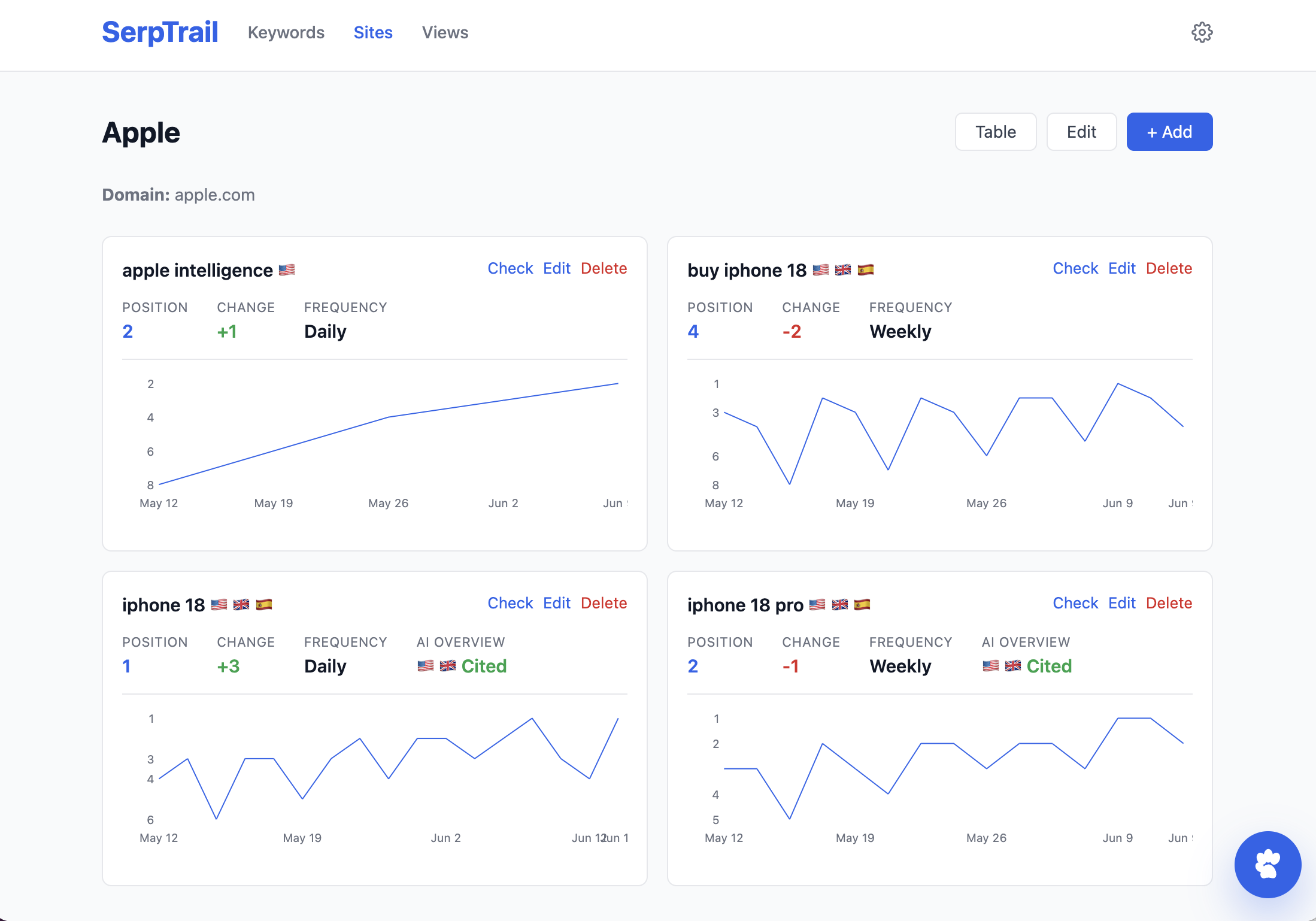
We built our own take on this idea. SerpTrail, our self-hosted rank tracker, runs in Docker with Rails and SQLite. It tracks Google rankings and AI Overviews across multiple locations on a daily, weekly, biweekly or monthly schedule. It can check up to five pages of Google results, and the source code is on GitHub. It runs on your SerpApi key, so the free plan's 250 searches are enough to try it.
What makes an accurate rank tracker?
An accurate rank tracker is one that reports the results page your customers actually see. There is no single "true" position for a keyword. Google builds each page from the searcher's location, device, language and the moment of the search. A tracker is accurate when it controls all four and keeps them the same from one check to the next.
Location, device, language and time
Location matters most for anything with local intent. A national check and a check from a specific city can return different pages, so set the location at city level when it matters. If you target several countries, our guide to global SEO strategies covers how results shift by market and language. Match the language (hl) and country (gl) to your audience too.
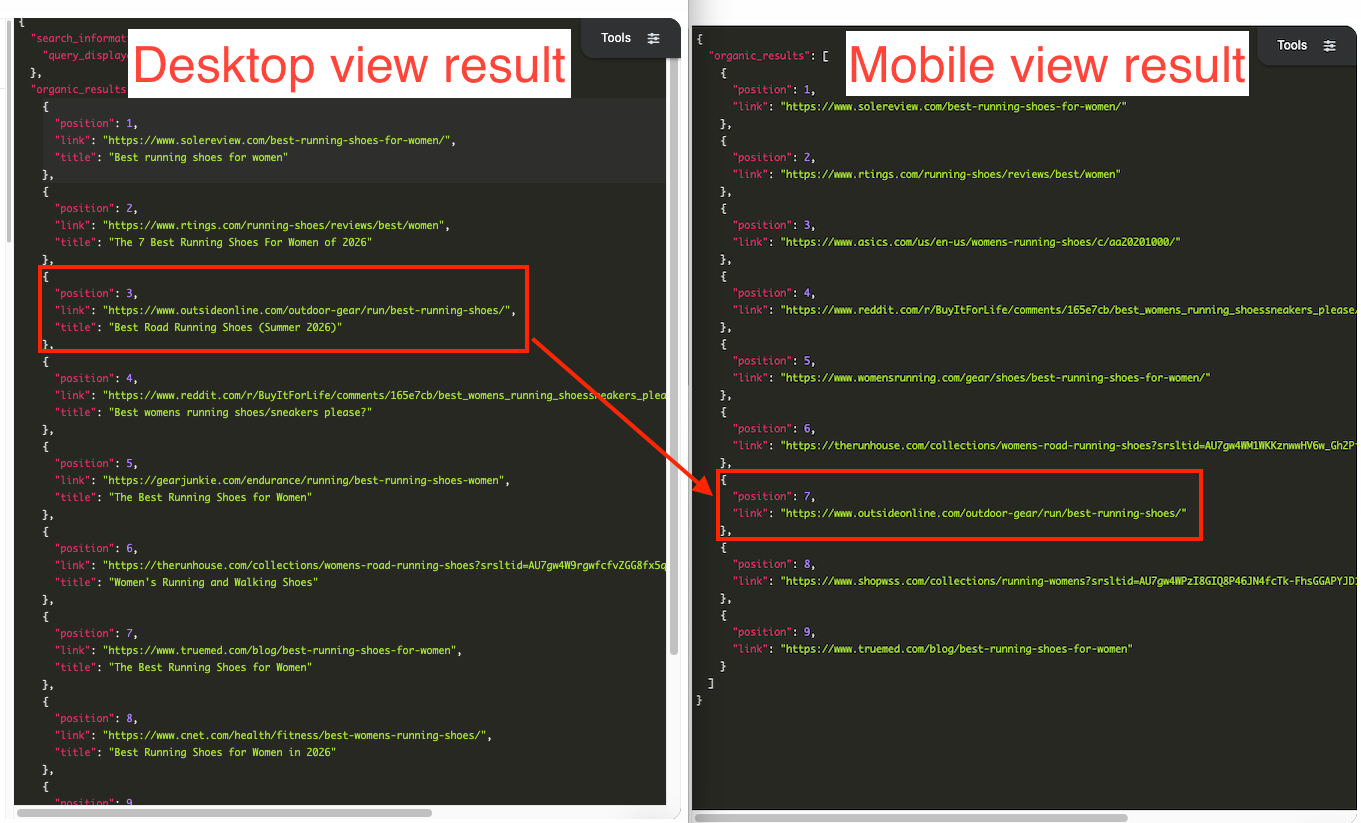
Device is the next big factor. On October 6, 2026, we ran "best running shoes for women" through SerpApi from Austin, Texas, once on desktop and once on mobile. Desktop returned 10 organic results and mobile returned 9. Only 6 pages appeared in both. Outside Online ranked #3 on desktop but #7 on mobile, and GearJunkie's #5 desktop result didn't appear on mobile at all.
Time of check matters because rankings move during the day. Check at the same hour each day so changes reflect Google, not your schedule.
Why tools and humans see different results
A common complaint is that a tool's ranking doesn't match a manual search. Usually the tool isn't wrong. This is caused by the person searching being logged in, having search history, or sitting a few miles from the location the tool uses. Accuracy comes from consistent parameters more than from any one provider.
The num=100 change
In September 2025, Google stopped supporting the num=100 parameter, which many tools used to fetch 100 results in one request. Tracking the top 100 now takes about 10 paginated requests per keyword. Ask any provider how it handles depth and how it bills for it.
Check against Search Console and pixel position
Google Search Console is a useful sanity check. Its average position blends every location and device, so it won't match a single check. But a large, lasting gap between the two is a sign to recheck your tracker's settings.
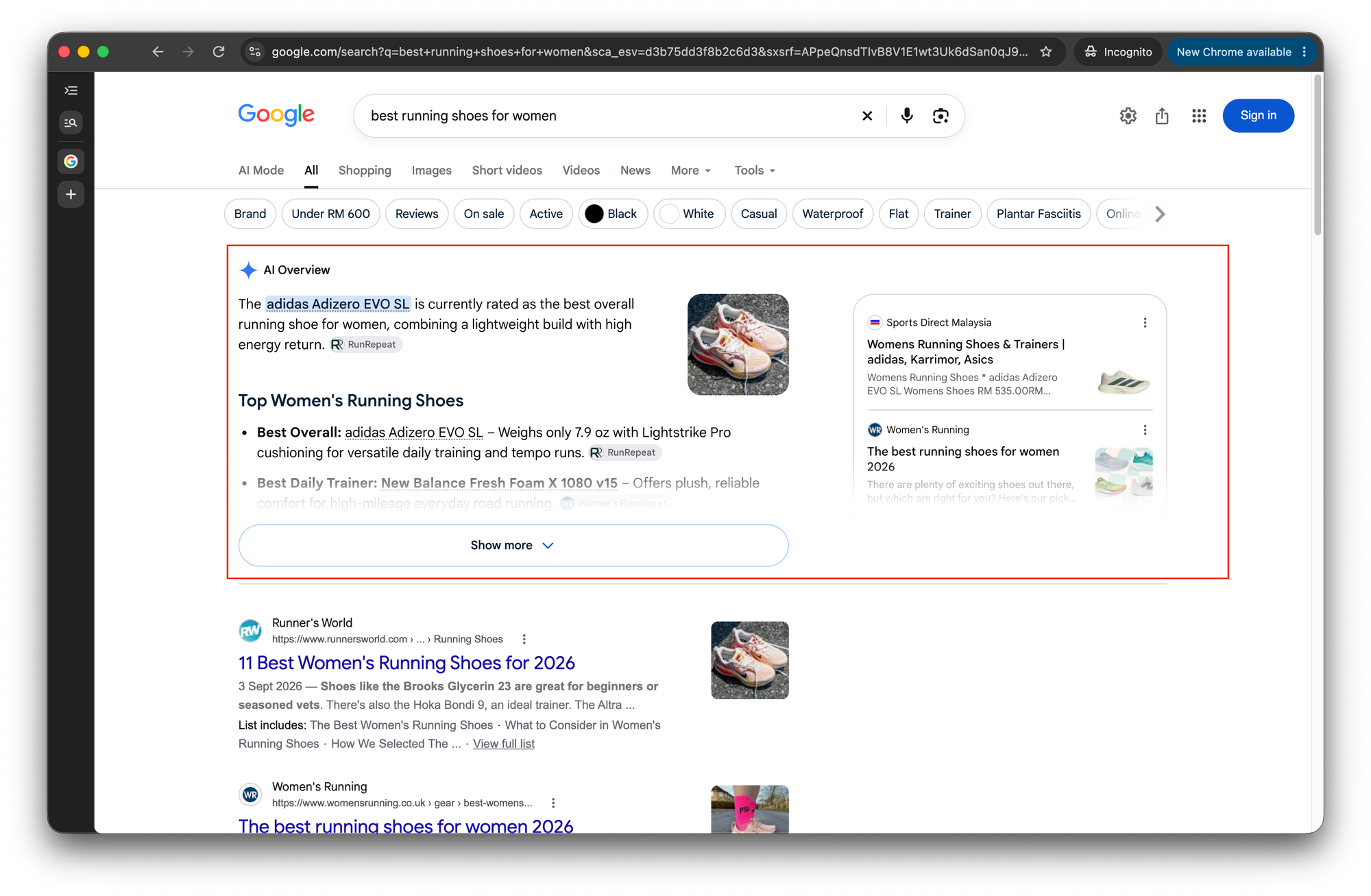
Position number alone also hides how visible a result is. A #1 organic result can sit below an AI Overview, ads and a local pack. Pixel ranking measures how far down the page a result appears, which tells you whether it is seen without scrolling. For more on how AI Overviews changed what a ranking means, read rank tracking in the age of AI Overviews.
Mobile rank tracking through an API
Google uses mobile-first indexing, which means it uses the mobile version of a page for indexing and ranking. That doesn't mean desktop and mobile results are the same. The mobile page has a narrower layout, shows SERP features in a different order, and often places local packs higher. As our Austin test showed, the set of pages can differ as well as their order.
For most sites, a large share of searches happen on phones. If you only track desktop, you may be looking at rankings that most of your visitors never see.
Mobile doubles the call count
Every device is a separate search. Tracking 500 keywords daily on desktop and mobile means 1,000 checks a day, not 500. With a SERP API, that doubles your bill. Rank trackers handle it differently. Some count a mobile keyword as a separate tracked keyword, while others include both devices. Ahrefs, for example, says mobile rankings are available on all Rank Tracker plans. Check this before comparing prices.
What to check before you pick a provider
- A device parameter. The API should accept a mobile device value. Some APIs have separate options for iOS and Android tracking, and a tablet setting.
- Location depth on mobile. City-level targeting matters even more on mobile, where local results take up more of the screen.
- SERP features in the mobile response. Make sure local packs, AI Overviews and other features are parsed for mobile, not only desktop.
- How mobile is billed. Find out whether a mobile check costs the same as desktop or counts against a separate limit.
One of the seven APIs in this guide, Serpent API, has no device parameter in its documentation. That rules it out for mobile rank tracking.
The 7 best rank tracking APIs
We start with the four SERP APIs, then cover the three rank tracker APIs. For each one, we cover targeting, data freshness, AI Overview support, cost and where it falls short.
1. SerpApi
SerpApi is a real-time SERP API. Each request runs a live Google search and returns the parsed results page as JSON or Markdown. It also covers Bing, YouTube, Google Maps and dozens of other engines through the same key.
- Type: SERP API
- Best for: teams that need precise location and device control, or that want rankings inside their own product
- Location and device targeting:
locationat city level,uule, orlatandlonwith aradius. Setgl,hlandgoogle_domainfor country and language.deviceaccepts desktop, tablet or mobile. - Refresh and scheduling: real-time on every call, on whatever schedule you set. Results are cached for an hour, and cached searches are free. Add
no_cacheto force a fresh search. SerpTrail adds daily, weekly, biweekly or monthly scheduling if you don't want to write your own. - AI Overview parsing: returned in an
ai_overviewblock. Sometimes Google loads it separately, and the response includes apage_tokenyou pass to the Google AI Overview API. - Starting price and free tier: 250 free searches a month. Paid plans start at $25 for 1,000 searches, then $75 for 5,000 and $150 for 15,000. Only successful searches count, so errors and failed searches are free. See every plan on the SerpApi pricing page.
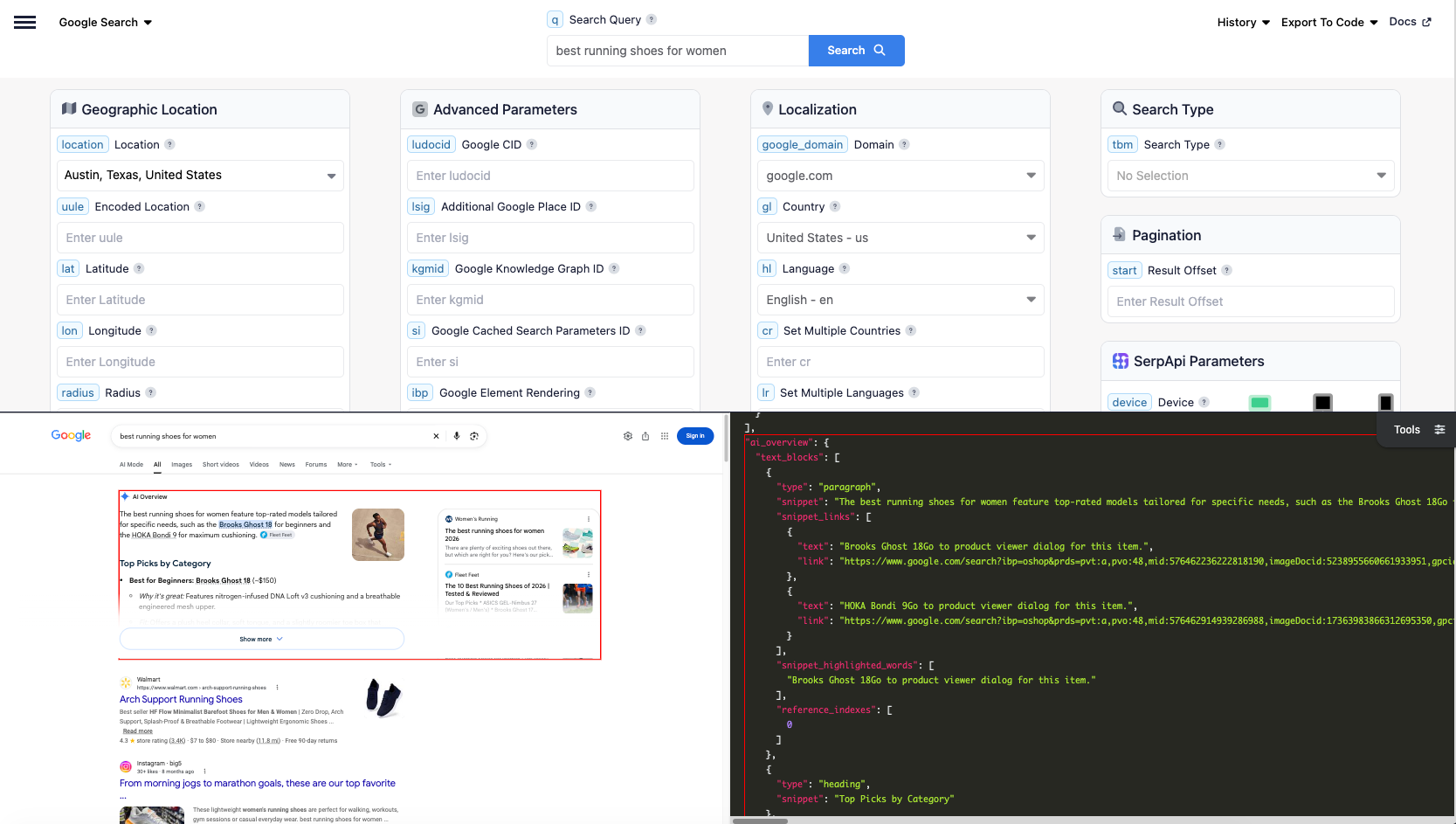
A few extras matter for rank tracking. The Pixel Position API (output=json_with_pixel_position) returns the on-page coordinates of each result, so you can measure pixel rank as well as position. Production plans and above include the U.S. Legal Shield, which covers legal questions around scraping public search results. SerpApi also offers an MCP server, so AI assistants can run searches directly.
Limitation: SerpApi costs more per search than queue-based APIs. At 30,000 searches a month, it is $275 against $18 on DataForSEO's standard queue. There is also no way to fetch 100 results in one request. You page through with start, and each page is one search.
2. DataForSEO
DataForSEO sells SERP data by the request, with three speed tiers. You post a task and collect results later, or pay more to get them live.
- Type: SERP API
- Best for: high-volume tracking where cost per keyword matters more than speed
- Location and device targeting:
location_code,location_nameorlocation_coordinate(latitude, longitude and radius).deviceis desktop or mobile, andossets Windows, macOS, Android or iOS. - Refresh and scheduling: the standard queue returns in about 5 minutes. Live mode returns in up to about 6 seconds.
depthgoes up to 700 results, billed per page of 10. - AI Overview parsing: returned as an
ai_overviewitem. Settingload_async_ai_overviewfetches ones Google loads separately, for an extra $0.0006 per task. - Starting price and free tier: $0.0006 per SERP on the standard queue, $0.0012 on priority and $0.002 live. New accounts get $1 of credit and a free sandbox.
DataForSEO is the cheapest per search of the SERP APIs here. If you track tens of thousands of keywords a day and can wait a few minutes, that gap adds up quickly.
Limitation: the cheapest tier uses a post-then-fetch workflow, which means more code than a single synchronous call. There is no tablet device option.
3. Serpent API
Serpent API is a low-cost SERP API that covers Google, Bing, Yahoo, DuckDuckGo and Brave. It is pay as you go, with discounts for larger deposits.
- Type: SERP API
- Best for: country-level desktop tracking on a tight budget, or tracking several search engines at once
- Location and device targeting:
countryandlanguageonly. The docs list no device or city parameter. - Refresh and scheduling: real time on each call.
numaccepts 1 to 100 andpagesaccepts 1 to 10. - AI Overview parsing:
include_aioon Deep Search requests, plusinclude_ai_modefor AI Mode. A paidpixel_positionoption is also available. - Starting price and free tier: $0.60 per 1,000 calls pay as you go, with a $10 minimum deposit. A $100 deposit unlocks 10× lower pricing and $500 unlocks 20× lower pricing. New accounts get free calls.
Serpent's own blog puts 1,000 keywords tracked daily at about $18 a month on the default tier. Paid credits never expire, which suits irregular usage. Promotional credits expire after 30 days.
Limitation: with no device or city targeting, Serpent API can't do mobile rank tracking or local rank tracking. It fits national desktop tracking only.
4. cloro
cloro is a SERP API with a credit system and a focus on AI search results, including AI Overviews.
- Type: SERP API
- Best for: tracking AI Overview presence next to classic rankings at a mid-range price
- Location and device targeting:
country(orgl), pluslocationby canonical name oruulefor city level.hlsets language.deviceaccepts desktop, ios, android or mobile. - Refresh and scheduling: real time on each call.
pagesfetches 1 to 10 pages. - AI Overview parsing: set
include.aioverviewfor an extra 2 credits per search. - Starting price and free tier: 500 free credits a month. Lite is $30 for 37,500 credits and Hobby is $100 for 250,000. Higher tiers bring the rate down to $0.31 per 1,000 credits.
The math for search credits is a bit complicated here. A Google search costs 3 credits, each extra page adds 2, and AI Overview adds 2. Synchronous requests add 2 more. A synchronous search with AI Overview therefore costs 7 credits.
Limitation: the headline price per 1,000 credits is not a price per search. Unused credits also don't roll over to the next month.
5. Semrush Position Tracking
Semrush Position Tracking is a full rank tracker inside the Semrush suite. Its API lets you create campaigns, add keywords and pull ranking reports into your own tools.
- Type: rank tracker API
- Best for: agencies and in-house teams already reporting from Semrush
- Location and device targeting: locations down to postal code. Devices are desktop, phone and tablet.
- Refresh and scheduling: daily updates, tracking up to the top 100 positions.
- AI Overview parsing: you can filter tracked keywords by SERP features, including AI Overview.
- Starting price and free tier: API access starts on the Advanced plan at $549 a month, billed monthly. There is no API access on the free plan.
API calls use Semrush API units on top of the subscription. Creating a campaign, adding a keyword and requesting a report each cost 100 units. Check how many units your plan includes before you plan a large integration.
Semrush's strength is everything around the rankings. Keyword volumes, competitor visibility and site audits live in the same account, so the ranking data connects to the rest of your SEO work.
Limitation: the price of entry is high if you only need ranking data. API units are a second cost to track, and you are tied to Semrush's daily schedule.
6. AccuRanker
AccuRanker is a dedicated rank tracker known for speed and on-demand refreshes. It is built for agencies and large in-house teams.
- Type: rank tracker API
- Best for: large keyword sets that need fresh data on demand
- Location and device targeting: country or local level. The pages we checked don't state device options.
- Refresh and scheduling: daily by default. You can also refresh one keyword or a whole domain on demand, every 2 hours.
- AI Overview parsing: not stated on the pages we checked.
- Starting price and free tier: an unlimited read API comes with the Expert plan at $764 a month. The write API, for adding keywords and domains, needs an Enterprise plan.
AccuRanker's features page describes full API access at no additional cost. That makes the read API good value if you already need Expert-level tracking. You can pull as much history as you like without counting units.
Limitation: the API sits behind a high-priced plan, and creating projects by API needs Enterprise. Confirm mobile tracking and AI Overview support with sales before you buy.
7. Ahrefs Rank Tracker
Ahrefs Rank Tracker is part of the Ahrefs toolset. Its API returns stored rankings for the projects you set up in Ahrefs.
- Type: rank tracker API
- Best for: teams already on Ahrefs who can work with weekly data
- Location and device targeting: country, state or province, or city. Each request sets
deviceto desktop or mobile. - Refresh and scheduling: weekly updates.
- AI Overview parsing: responses list SERP features, including
ai_overview. Abest_position_kindfield shows when your best position is inside an AI Overview. - Starting price and free tier: Lite costs $129 a month and includes 750 tracked keywords. It also includes API and MCP access with 1,000 credits per user.
The rank-tracker-overview endpoint needs a project ID, a device and a date. It returns position, URL, location and SERP features for each keyword. Ahrefs also offers an MCP server, so you can query rankings from an AI assistant.
Limitation: weekly data misses short-term swings, such as the days after an algorithm update. The 1,000 API credits on Lite also limit how often you can pull data.
What rank tracking costs per keyword
SERP APIs charge per search, so the cost of tracking comes down to one formula:
Monthly searches = keywords × devices × locations × checks per month
Take a common setup: 500 keywords, checked on desktop and mobile, from one location, every day. That is 500 × 2 × 1 × 30, or 30,000 searches a month. Here is what that costs with each provider.
Provider | What 30,000 checks needs | Monthly cost | Notes |
|---|---|---|---|
SerpApi | 30,000 searches | $275 (Big Data plan) | Real time; failed and cached searches are free |
DataForSEO | 30,000 SERPs | $18 standard, $36 priority, $60 live | Standard queue takes about 5 minutes |
Serpent API | 15,000 calls (desktop only) | About $9 | No mobile option, so half the setup isn't possible |
cloro | 90,000 to 210,000 credits | $100 (Hobby plan) | Range depends on AI Overview and sync requests |
Semrush | 500 keywords in Position Tracking | $549 + API units | Advanced plan needed for API |
AccuRanker | 500 keywords | $764 (Expert plan) | Unlimited read API |
Ahrefs | 500 keywords | $129 (Lite plan) | Weekly updates only, so not a like-for-like match |
Three things change the math. Each extra location adds another full set of searches. Tracking beyond the top 10 multiplies SERP API costs, since the end of num=100 means each extra page is a separate request. And rank trackers bill by tracked keyword, so their price stays flat however often they check.
For small keyword lists, a rank tracker can be the simpler buy. Once you track many locations or devices, a SERP API is usually cheaper per check.
FAQ
What is the best rank tracker tool?
It depends on how you'll use the data. For dashboards and client reports, a rank tracker such as Semrush, AccuRanker or Ahrefs is the simplest choice. For tracking inside your own app, or across many locations and devices, use a SERP API like SerpApi or DataForSEO. You get more control at a lower cost per check.
Which AI-powered rank tracker is the best?
Most tools now report AI Overviews in some form. Ahrefs and Semrush flag when one appears for a tracked keyword. SERP APIs like SerpApi, DataForSEO and cloro return the AI Overview text and its cited sources, so you can see whether your site is cited. To try this yourself, follow our guide to track AI Overview rankings in Python.
How do I check my ranking?
For a one-off check, search in a private browser window with location set to your target city. Then compare with the average position in Google Search Console. For ongoing tracking, use a rank tracker or a SERP API so every check uses the same location, device and language.
Start tracking your rankings
SerpApi gives you real-time Google results with city-level and device targeting, AI Overview parsing and pixel positions. Failed searches are never billed. Sign up for a free account to get 250 free searches a month, then try your first ranking check in minutes.
If you need help getting started, contact us. We're happy to help.