









 Ruby
Ruby
 Golang
 .Net
.Net
 MCP
MCP
 C++
C++

If you're comparing SEO platforms to choose where your search data comes from, whether it's for rank tracking, dashboards, or a Google search ranking API integrated into your product, both DataForSEO and SerpApi are strong options. At a quick glance, they seem similar, but they have important differences.
Live Search Data vs SEO Platform
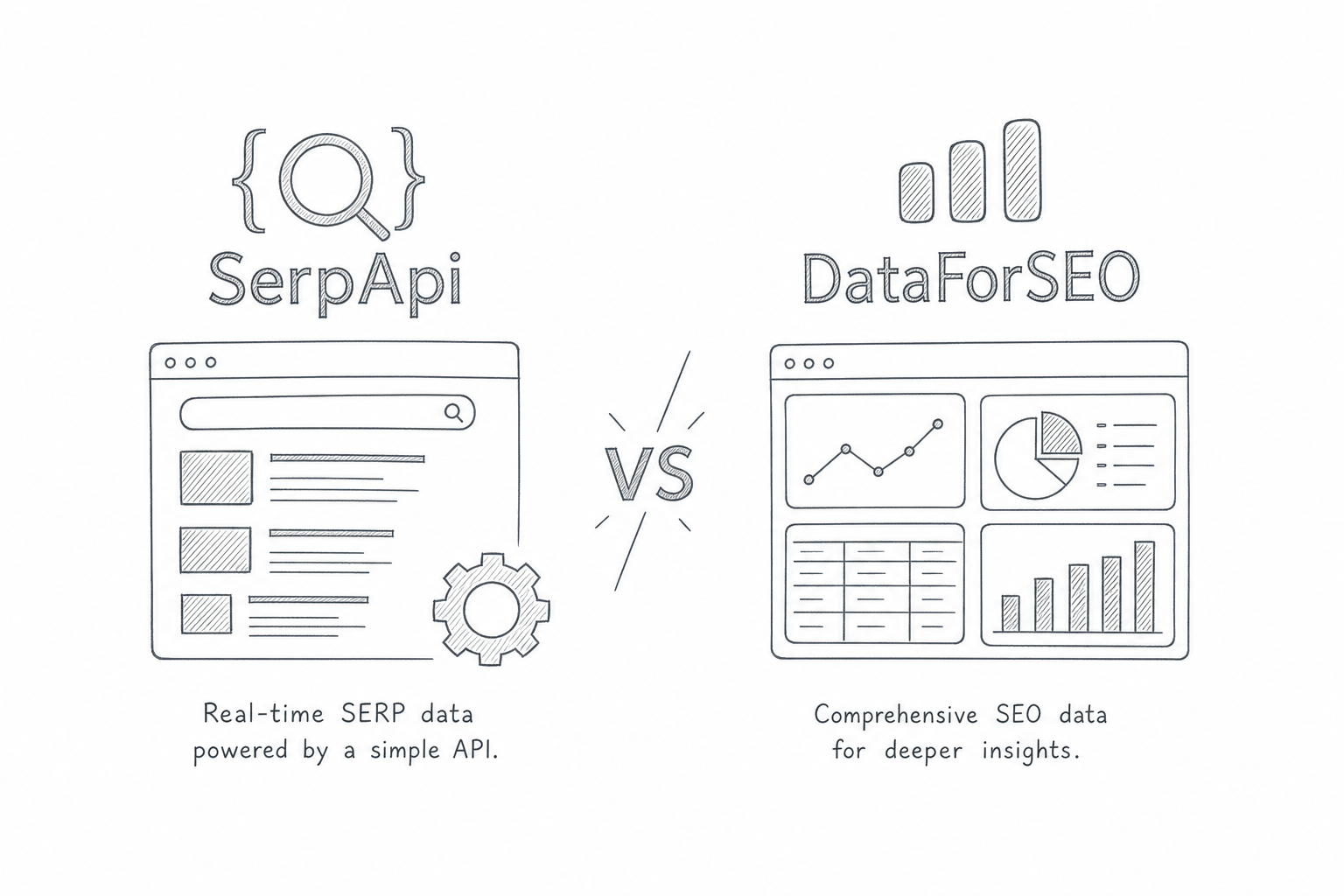
Despite the overlap on Google SERP data, SerpApi and DataForSEO are built around two different priorities. Which option fits best depends more on your priorities than on any single line item. Price is part of it, and we'll be straight about it further down.
DataForSEO is a broad, pay-as-you-go SEO data platform. Beyond SERPs, it provides backlinks, keywords, on-page, domain analytics, and more, all billed per request from a prepaid balance. Its strongest selling point is low-cost data at scale. It's the raw layer that many SEO dashboards are built on.
SerpApi is a real-time web search API. You make a call, and it returns structured JSON of what a search engine shows for that query. The results include AI overviews, organic results, ads, featured snippets, People Also Ask, the local pack, Shopping, and more than 100 SERP feature types. Its best features are speed, coverage, and developer experience.
DataForSEO is optimized to be the most cost-effective way to store search data. SerpApi is optimized to be the fastest, most complete way to query it in real time. Picking between them is really about which of those two jobs is yours.
Data Freshness
The most consequential difference between SerpApi and DataForSEO is how the results reach you.
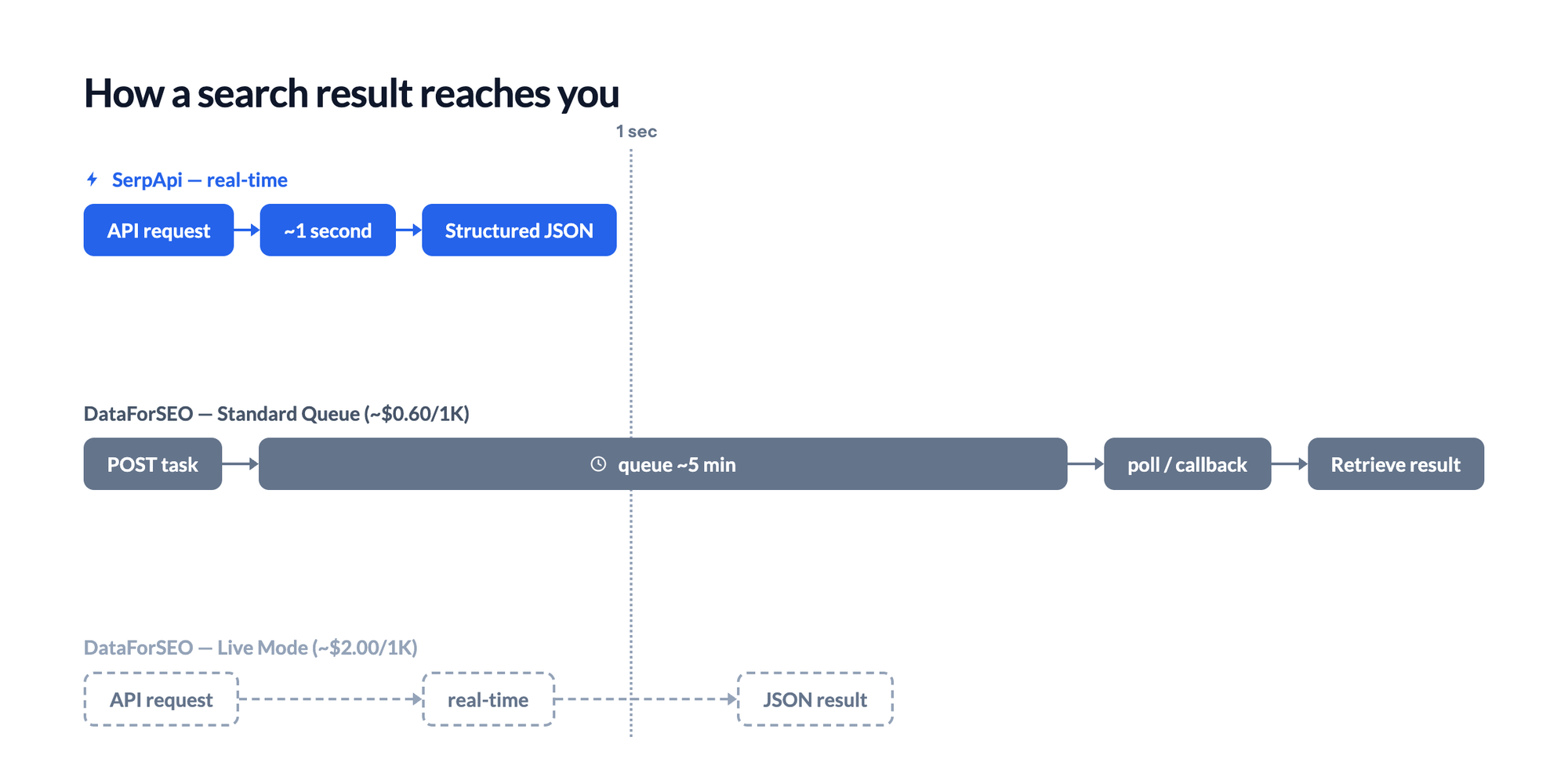
DataForSEO's default model is a queue. You submit a task, wait, and retrieve the result later. On the Standard Queue, turnaround is typically around 5 minutes (a Priority Queue cuts it to about 1 minute, and a synchronous Live Mode runs at a higher rate). For batch rank tracking that runs overnight, where five minutes is insignificant, the queue is perfectly suited.
But if your application is customer-facing or agent-driven, where a user types a query and waits, or an LLM that needs search results mid-response, five minutes is a non-starter, and even one minute is. For those workloads, the queue isn't an option. You're choosing between DataForSEO's Live Mode and SerpApi. And "live" doesn't mean equally fast: in our own reproducible benchmark, SerpApi averaged 0.73 seconds per query, compared to 3.57 seconds for DataForSEO's fastest option, and the worst-case gap was wider still, with a p99 of 1.45 seconds versus 13.31 seconds. DataForSEO's own comparison points in the same direction, measuring its live mode at around 6 seconds. For an AI agent making several search calls in a single chain, that difference compounds quickly.
SerpApi is synchronous by default. Every call returns live results in roughly a second, and with Ludicrous Speed / Ludicrous Speed Max you can push median response times well below that. We benchmarked response times across providers in who has the fastest Google Search API. There’s no queue to manage, no task-polling loop to construct. The optional Search Archive API is available if you want to re-fetch past searches; it's for convenience, not a required step. For real-time workloads, fast processing determines whether you can deliver the feature or not.
Do you actually need real-time data?
It's worth meeting the strongest version of the other side head-on because DataForSEO-leaning comparisons have highlighted that most SEO work is batch-based, so you're paying a premium for speed you'll never use. For pure scheduled SEO, such as overnight rank tracking or weekly content-gap reports, that's fair. If nothing is waiting on the result, the queue is the right call.
The argument breaks down on two points. First, the number of applications requiring real-time results is growing rapidly. Gartner estimates that 40% of enterprise applications will have task-specific AI agents integrated by the end of 2026, up from under 5% in 2025. Agents, RAG pipelines, in-product search, and live AI-Overview / GEO monitoring all need a result in a single request. The moment a human or an agent is waiting, the comparison becomes Live Mode at ~ $2.00/1K versus SerpApi. That's a much smaller gap than the headline numbers suggest, and part of it buys back real engineering time. With a synchronous API, there's no poll-and-retrieve layer to build, debug, and maintain.
Second, when DataForSEO-leaning comparisons concede that the queue can't serve real-time use cases, the workaround they tend to suggest is to pair it with Google's Custom Search JSON API for live queries. That pairing doesn't hold up. The Custom Search API is capped at low daily volume, returns a restricted custom-search index rather than the live public SERP, and omits most SERP features and verticals. Offering it as the real-time answer mostly confirms that it's the queue being defended, not your latency needs being met.
The real question is simpler than "batch or real-time": does anything wait on the result? If so, compare SerpApi against Live Mode, and count the poll-and-retrieve layer you won't have to build.
Let's take a look at two scenarios that show how this plays out.
For the SaaS team, the queue is fine for weekly rank reports that can be processed in batches. But AI Overview citations aren't. They appear, vanish, and swap sources far faster than bluelinks move, and being cited for the "best <your category> software" is the new position #1. Monitoring on day-old snapshots means learning you lost the citation days after a competitor's page replaced yours. Checking live means alerting the content team while the cause is still identifiable and answerable.
For an e-commerce team, the gap is larger because automation acts directly on the data. Google Shopping positions are reshuffled in response to competitor price changes, sometimes hourly. So a repricing engine or Minimum Advertised Price (MAP) violation monitor running on 5-minute-old queue data can act on prices that no longer exist. A human reading a stale report adds judgment before acting. An automated repricer doesn't get that chance.
DataForSEO pricing vs. SerpApi pricing
If you're sizing up SerpApi as a DataForSEO alternative, the prices only make sense once you know which speed tier you'd actually use.
DataForSEO is pure pay-as-you-go. No monthly subscription. You prepay a balance (a $50 minimum deposit, with a $1 free trial credit to test first) and draw it down per request. For the SERP API, the same query costs a different amount depending on how fast you need it:
| DataForSEO SERP API tier | Price per 1,000 SERPs | Delivery |
|---|---|---|
| Standard Queue | ~ $0.60 | Queued, ~ 5 min turnaround |
| Priority Queue | ~ $1.20 | Queued, ~ 1 min turnaround |
| Live Mode | ~ $2.00 | Real-time, synchronous |
(Base price covers the first 10 results. Since Google removed its num=100 parameter in late 2025, deeper result pages are billed per additional page budget for that if you paginate.)
SerpApi is subscription-based, priced on a monthly bucket of successful searches:
| SerpApi Plan | Price | Searches/Month | Price per 1,000 Searches |
|---|---|---|---|
| Free | $0 | 250 | - |
| Starter | $25 | 1,000 | $25.00 |
| Developer | $75 | 5,000 | $15.00 |
| Production | $150 | 15,000 | $10.00 |
| Big Data | $275 | 30,000 | ~ $9.17 |
Plans scale up to 1,000,000+ searches/month, and an Enterprise tier offers reserved and on-demand pricing for high volume. Only fully successful searches count. While cached, errored, blocked, and CAPTCHA requests are free, unused searches don't roll over.
Look at those two tables side by side, and the takeaway is simple: at the same volume, DataForSEO's price is lower, and it is the better fit for latency-tolerant batch work. SerpApi is the premium option. That's what you get for the real-time speed, one-call integration, wider search-surface coverage, human support, and legal cover, which is what the rest of this comparison walks through.
Ease of Integration
This one rarely makes the spec sheet but shows up on day one of building.
SerpApi
With one API key, you get synchronous request and structured JSON back. Plus, official libraries are available for Python, Ruby, JavaScript, Go, PHP, Java, .NET, Rust, and more, plus an MCP integration for AI assistants.
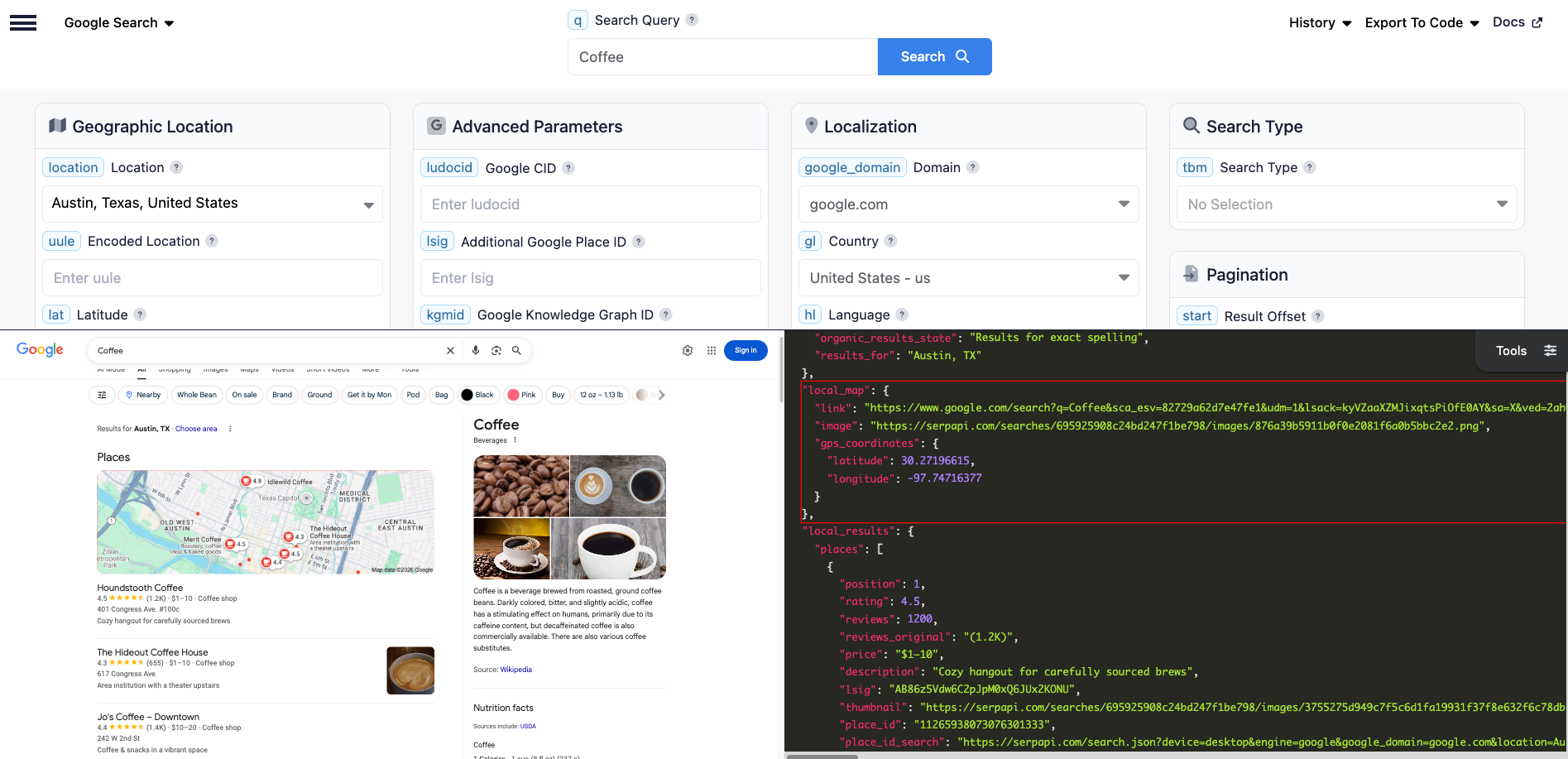
For quick testing, the playground lets you run a search query with zero code, and one thing I really like about it is that it shows a visual preview of the SERP on the same page you'd see in a regular browser, side by side with the JSON response. When I'm tracing where a field comes from ("which box on the page is this organic_results object?"), I can see the element and its parsed data side by side. DataForSEO's output is JSON only, so mapping a field back to what actually appeared on the page requires opening a browser and reconstructing the SERP yourself. It sounds small. But it stops being small the first time you debug why a value isn't where you expected it to be.
DataForSEO
The authentication uses a login-plus-API-password credential pair, and the queued endpoints follow a task-based pattern. You POST a task, then either poll for results or wait for a callback to retrieve them. It's well-documented and fine once built, but it really involves more work than a single synchronous GET. (DataForSEO also ships an MCP server, so for AI-assistant workflows, both options exist.)
For solo developers or small teams trying to ship faster, integration friction creates real costs, even if it doesn't appear on the invoice.
Coverage
"Which one covers more?" depends on more of what.
On SERP engines and Google verticals, SerpApi is wider. DataForSEO's SERP API spans roughly 8 engines (Google, Bing, Yahoo, Baidu, Yandex, Naver, Seznam, YouTube). SerpApi supports 100+ APIs across Google Search, Maps, Shopping, Scholar, Trends, Flights, Hotels, Lens, Jobs, News, Patents, and more, as well as Bing, Baidu, Yandex, Naver, DuckDuckGo, Amazon, eBay, Walmart, YouTube, Yelp, Tripadvisor, and others. If your roadmap touches multiple search surfaces, that range matters.
In terms of SEO data types, DataForSEO offers a broader range. Backlinks, a historical keyword database, on-page audits, domain analytics, and its API list go well beyond SERPs. SerpApi doesn't support these features because its main focus is on the web search API rather than an SEO data suite. If you need backlink graphs or a keyword-volume database alongside SERPs, DataForSEO consolidates that in one account.
In short, SerpApi provides the depth and freshness of live search results parsing across many search engines, while DataForSEO provides a wider range of raw SEO datasets in one place.
SerpApi Endpoints That Affect SEO Decisions
Several endpoints return the exact signals that SEO teams call on. A few worth knowing, covered by both SerpApi and DataForSEO:
- Pixel Position: the real-browser X/Y coordinates of each result. Nominal "rank #1" can sit well below the fold once ads, an AI Overview, and a featured snippet stack above it. Pixel Position reports actual above-the-fold visibility, per device, so you can tell which rankings are worth defending and which are wins only on paper.
- Google AI Overview and AI Mode: whether your content is cited in Google's AI answers, and which domains are. This is the core AEO/GEO decision of 2026: track AI visibility the way you track bluelink rank. We've written about what AI Overviews change for rank tracking in depth.
 Hilman Ramadhan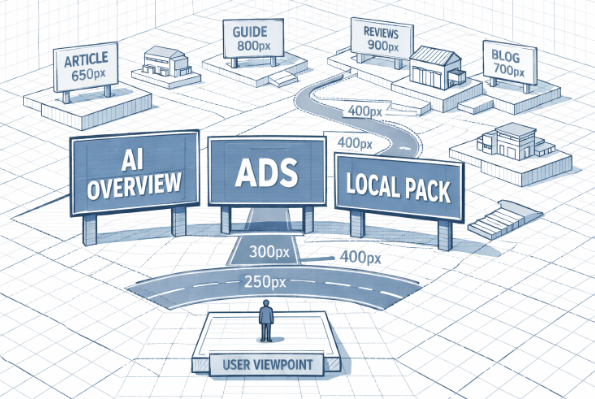
- Related Questions (People Also Ask): the questions Google attaches to a query, which map straight to content gaps, FAQ blocks, and subheadings worth writing.
- Autocomplete: the long-tail variations real users actually type, for keyword discovery grounded in live suggestions rather than a static database.
- Google Trends: demand direction and seasonality, so you prioritize topics that are rising rather than fading.
- Google Local: local-pack results by location, for tracking visibility, where the map results, not the organic ones, win the click.
Some endpoints currently lack DataForSEO equivalents, such as the Google Forums API (covering the "Discussions and forums" SERP block where Reddit visibility appears), Google Short Videos, and Bing's vertical results beyond organic Copilot, Images, Maps, News, and Shopping, where DataForSEO only covers organic Bing results.
The key difference is that SerpApi returns the results in a single, real-time call, parsing them in a structured JSON format. This introduces the same real-time versus queued trade-off mentioned earlier, but specifically applied to the signals that inform SEO decisions.
Feature Comparison
Here's the full picture in one place with everything we covered so far, plus a few dimensions that haven't come up yet:
| Dimension | SerpApi | DataForSEO |
|---|---|---|
| Core model | Real-time search API (subscription) | SEO data platform (pay-as-you-go) |
| Default delivery | Synchronous, ~1 sec | Queued (Standard/Priority); Live mode synchronous |
| Pricing | From $25/mo (1K searches); free tier 250/mo | From $0.60/1K (queued) to ~$2.00/1K (live); $50 min deposit |
| SERP engines | 100+ APIs incl. many Google verticals | ~8 SERP engines |
| Other SEO data | SERP-focused (no backlinks/keyword DB) | Backlinks, keyword DB, on-page, domain analytics |
| SERP feature parsing | 100+ feature types as structured objects | Rich features via "Advanced" result type |
| Integration | Single API key, sync request | Login + API password, task-based queue workflow |
| Legal | U.S. Legal Shield assumes scraping liability for you | No Legal Shield |
| Transparency | Public status page + public roadmap | Status page; private roadmap |
| Best fit | Real-time apps, AI agents, multi-engine SEO tools | High-volume batch data, cost-sensitive pipelines, full SEO suites |
Main differentiators
Legal posture. These aren't the same promise. DataForSEO states that scraping publicly available SERP data isn't a CFAA/DMCA violation. i.e., we believe this is legal. SerpApi's U.S. Legal Shield goes further: on recurring paid plans, SerpApi contractually assumes liability for scraping and parsing on your behalf (short of genuinely illegal use). If legal risk transfer is something your company needs in writing, that's a SerpApi-specific feature, not a line item in the price.
Transparency. SerpApi publishes a public status page with 30-day average response times filterable by engine, and a public roadmap where anyone can see bugs and file feature requests consistent with the company's "painful honesty" value. For the infrastructure you're betting a product on, being able to inspect reliability before you commit is worth weighing.
When to choose each
Choose DataForSEO when:
- Unit cost is your binding constraint, and you're operating at high volume.
- Your workload is batch and latency-tolerant, such as overnight rank tracking and bulk SERP snapshots.
- Your usage is spiky, and you'd rather pay only for what you consume than fit into a monthly bucket.
- You need backlinks, a keywords database, or on-page data in the same account as your SERPs.
Choose SerpApi when:
- Your app is customer-facing, or agent-driven, and results need to be real-time.
- You want the simplest possible integration: one key, one synchronous call.
- You need a broad engine and Google-vertical coverage with high-fidelity SERP-feature parsing.
- Legal liability transfer, public transparency, and responsive support are part of the decision.
- You'd rather not build and maintain a task-queue retrieval layer.
FAQ
Is DataForSEO actually cheaper than SerpApi?
On headline per-query price, yes, especially on the Standard Queue (~$0.60/1K vs. SerpApi's $25/1K entry rate). The gap narrows when you need real-time results, since you'd use DataForSEO's Live Mode (~$2.00/1K). And it narrows further once you price in integration time, latency requirements, and whether you need legal cover. Cheapest-per-query isn't the same as cheapest-for-your-project.
Can DataForSEO do real-time?
Yes, via Live Mode, which is synchronous but priced higher than its queued tiers. SerpApi is real-time by default across all plans.
Which has more search engines?
SerpApi, by a wide margin on SERP such as Google, Bing, DuckDuckGo, Baidu, Yandex, Naver, Yahoo, YouTube, Yelp, Tripadvisor, Amazon, eBay, Walmart and more (100+ APIs). DataForSEO covers more SEO data types (backlinks, keyword DB, on-page) but fewer SERP engines.
Can I use both?
Plenty of teams do. DataForSEO for cheap, high-volume batch collection, SerpApi for the real-time and multi-engine paths. They're not mutually exclusive.
Which is the best SERP tracking tool, SerpApi or DataForSEO?
Neither is a turnkey rank tracker. Both are API layers you'd build a SERP-tracking tool on top of. For tracking that runs on a schedule, DataForSEO's queue is cost-efficient, but for tracking that updates on demand or inside a user-facing dashboard, SerpApi's real-time responses are the better fit. Pick the data layer that matches how your tool refreshes.
Is SerpApi a good DataForSEO alternative?
If your use case is real-time or spans multiple search engines, yes — SerpApi covers the SERP side with lower latency and simpler integration. But if you also rely on backlinks, a keyword database, or on-page audits, SerpApi won't replace those parts of DataForSEO. In that case, the answer to "what's the best DataForSEO alternative" is often SerpApi plus a dedicated tool for the rest, rather than a single swap.
Related comparisons
Weighing SerpApi against other providers? We've broken down the trade-offs in each of these:
- SerpApi vs. Brave Search API
- SerpApi vs. Exa AI
- SerpApi vs. Firecrawl: search intelligence vs. website content
- SerpApi vs. Serper vs. ValueSERP vs. SearchApi
- Who has the fastest Google Search API?
The bottom line
DataForSEO and SerpApi appear to be competitors because both provide Google SERP data. But you're choosing between a pay-as-you-go data warehouse and a real-time search API, and the right answer falls out of one question: is your bottleneck unit cost, or latency, coverage, integration speed, or legal cover?
If you're warehousing search data at scale on a tight budget and can tolerate a queue, DataForSEO's prices are definitely lower. If you're building something where results need to arrive now, such as an AI agent, a customer-facing product, a multi-engine SEO tool, and you'd rather ship than build retrieval plumbing, that's exactly what SerpApi is for.
The good news: you don't have to take anyone's word for the trade-offs. SerpApi's status page and roadmap are public, and the free plan includes 250 searches per month to test real responses against your own queries.
Try a query in the playground and compare the JSON for yourself! If you have questions, reach us at contact@serpapi.com.