 Google Local Services API
 Google Travel Explore API
 Baidu Search API
 Bing Search API
 DuckDuckGo Search API
 eBay Search API
 Naver Search API
 OpenTable Reviews API
 The Home Depot Search API
 Tripadvisor Search API
 Walmart Search API
 Ruby
Ruby
 Golang
 .Net
.Net
 MCP
MCP
 C++
C++

When comparing SerpApi vs Brave Search API, the fundamental question isn't about data quality in isolation; it's about data relevance. The Brave Search API queries a private, independent index of the web containing approximately 20 billion pages. Compare that to Google's index, which spans hundreds of billions of pages. Brave bills itself as privacy-first and independent from Big Tech. It's what you might call a "Sanitized Web", curated, lean, and intentionally isolated from the mainstream search ecosystem.
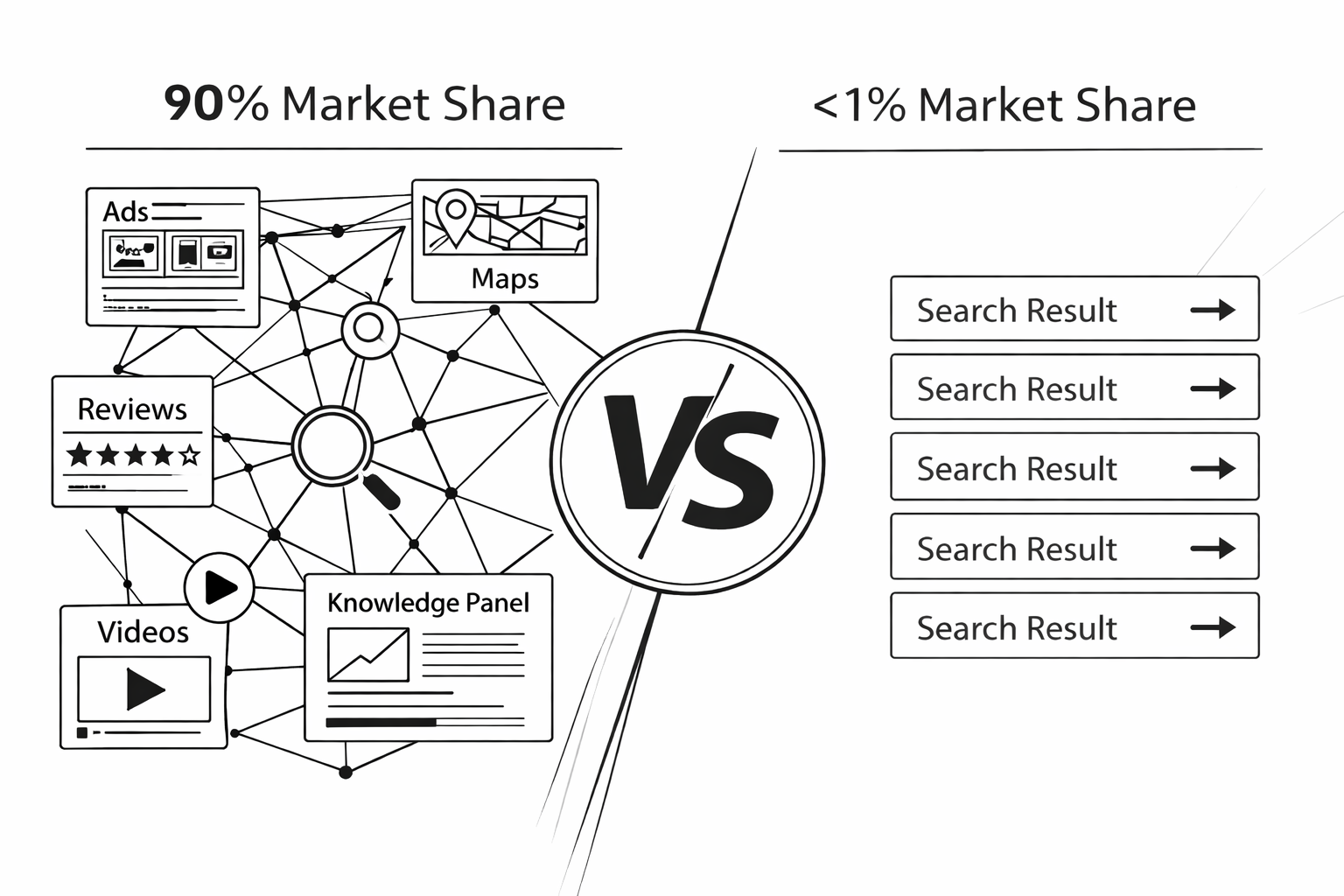
SerpApi takes a different approach. It scrapes the live results from Google, Bing, YouTube, and yes, even Brave if you need it. It's the "Real Web", the messy, commercial, algorithmically-ranked reality that your customers actually see when they search.
For generic retrieval-augmented generation (RAG) tasks like "What is the capital of France?" or "Explain photosynthesis," Brave works fine. The answer doesn't change based on which index you query. But for Business Intelligence questions like "Who is bidding on 'CRM software' in London?" or "What's the average price for wireless earbuds on Google Shopping right now?" Brave becomes statistically irrelevant.
The core issue isn't that Brave is bad. It's that Brave answers a different question. If your business depends on understanding what consumers actually see, where they click, what prices they compare, which local businesses appear in the map pack, then you're not just choosing between two APIs. You're choosing between building on top of the market or building in parallel to it.
The 1% vs. 90% Problem: Understanding Brave Search API Limitations
When evaluating Google Search API vs Brave, the market share statistics tell a sobering story. Google controls approximately 90% of the global search market. Bing sits at around 4%. Brave Search, despite its privacy credentials and growing user base, represents less than 1% of search traffic.
This creates what I call the "Vanity Metric" danger, one of the most critical Brave Search API limitations for commercial applications. Imagine you're building SEO rank tracking APIs for marketing agencies. Your clients want to know where their e-commerce site ranks for "running shoes" in New York. If you build this tool using the Brave Search API, you're reporting on a user base that effectively doesn't exist for most businesses.
Your dashboard shows their client is ranking #3 on Brave. That sounds great until you realize that Brave's <1% market share means the client is visible to a tiny fraction of potential customers. Meanwhile, on Google, where 90% of searches happen and where actual revenue gets generated, that same site might be on page 10. Your tool just gave them false confidence based on irrelevant data.
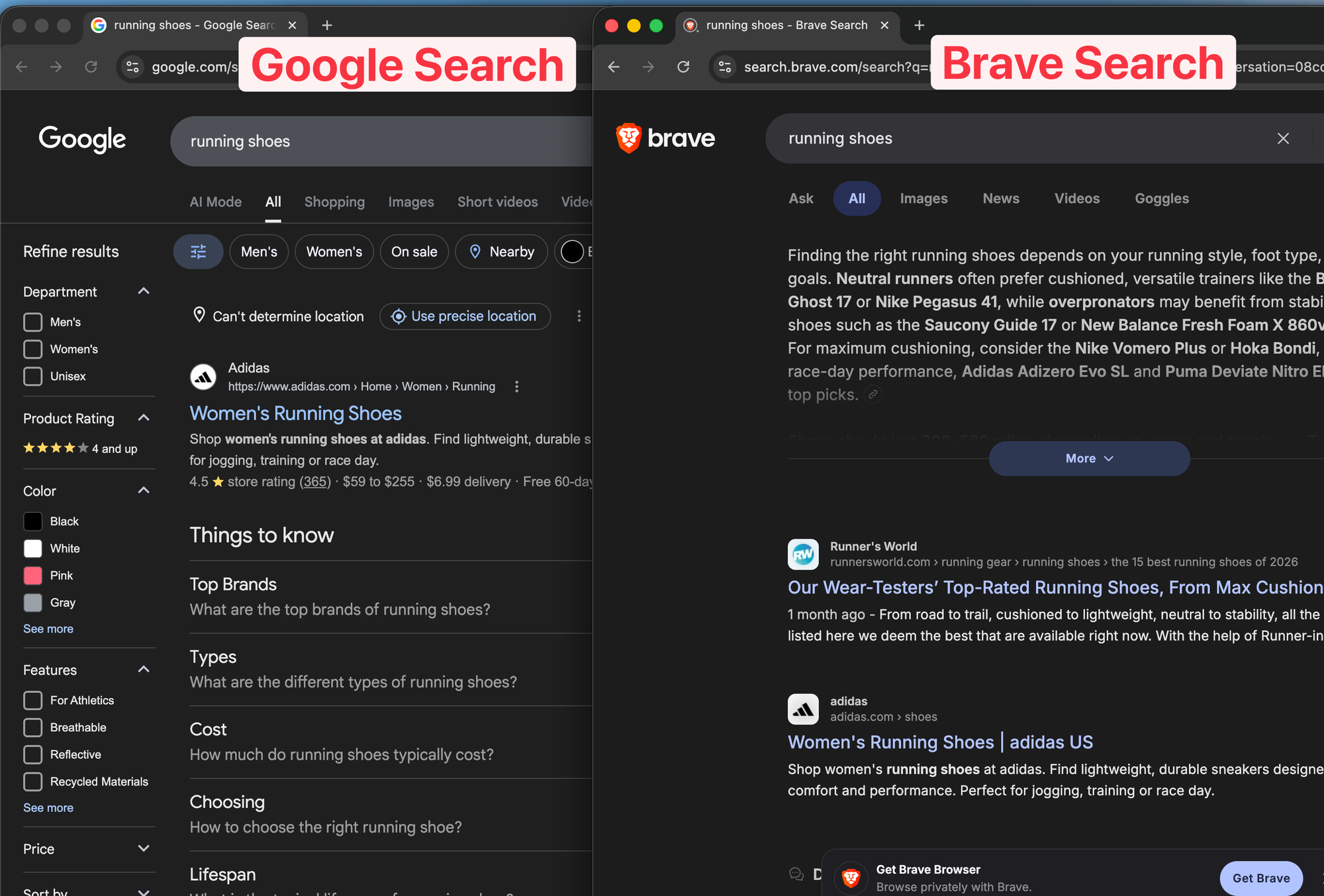
The problem compounds when you consider the algorithm gap. Brave's ranking algorithm is completely independent from Google's. It doesn't use PageRank, doesn't weight E-E-A-T signals the same way, and doesn't apply the same spam filters or helpful content system updates that Google deploys. The two search engines are fundamentally solving different optimization problems.
This means optimizing for Brave does not help you rank on Google. If you're an SEO tool provider giving recommendations based on Brave data, you're telling your users how to rank on a platform their customers don't use. There's no feedback loop between Brave performance and business outcomes because the traffic isn't there.
Only SerpApi gives you access to the ranking signals, ad positions, and SERP features from the platforms where revenue actually happens. When your customer asks "Why did our traffic drop 40% last week?" you need to see what Google changed in their SERP, not what Brave might hypothetically show to its tiny user base.
The use case for Brave data in SEO tooling is essentially academic. It's interesting for research on algorithmic diversity or privacy-preserving search. But if you're building a business that needs to predict, track, or optimize for search visibility that translates to revenue, you need Google data;. That's not an opinion, it's arithmetic.
The "Rich Result" Gap: Where Brave Search API Limitations Become Critical
Brave is primarily a text-link search engine. You query it, you get a list of URLs with titles and descriptions. For many use cases, that's sufficient. But the modern Google SERP is nothing like a list of ten blue links.
Google's "rich results" now dominate commercial queries. These include local packs, shopping carousels, knowledge panels, video results, featured snippets, and "People Also Ask" boxes. These elements aren't decorative; they're where clicks happen. Featured snippets can capture significant traffic on informational queries, often pulling clicks away from traditional organic results.
Brave has none of this. Here's what SerpApi captures that Brave misses:
Local SEO Data API Capabilities
Local Data: Brave has no equivalent to Google's Local Pack. When you search "coffee shop near me" on Google, you get a map, business hours, real-time busy times, photos, and review scores. SerpApi connects to Google Maps data, pulling these structured signals in real-time. If you're building a local SEO data API solution, a competitive analysis tool for restaurants, or a location intelligence platform, Brave literally cannot provide the data you need. It doesn't have relationships with local business databases or review platforms at the scale Google has built through Google Business Profile.
Shopping Data: Brave has no Shopping Graph. When you search "Sony WH-1000XM5" on Google, you see prices from a dozen retailers, shipping estimates, availability, and product ratings aggregated across the web. SerpApi scrapes Google Shopping to give you real-time price comparisons, seller reputations, and stock levels. If you're building a price monitoring tool, a dropshipping product research platform, or an AI shopping assistant, Brave gives you a link to Sony's website. SerpApi provides you with the competitive market landscape.
Visual Search: Brave's image search is generic web crawl data. SerpApi scrapes Google Lens and reverse image search, which use sophisticated computer vision models to identify products, landmarks, plants, and more. The difference is the layer of machine learning that Google applies to visual data, something Brave's index simply doesn't have at a comparable scale or accuracy.
Real-World Use Case Comparison
Here's a concrete example. You're building an AI travel agent. A user asks, "Find me a hotel in Barcelona near Park Güell under $150 per night."
Using Brave Search API, your agent searches "hotels near Park Güell Barcelona" and gets back a list of hotel websites and booking aggregators. It might scrape a few of those sites to find prices, assuming they're not blocked. You get generic results with no structured data.
Using SerpApi's Google Hotels integration, your agent gets back structured JSON with exact prices per night, availability for specific dates, review scores, photos, amenities, distance to Park Güell calculated by Google Maps, and direct booking links. You can filter by price programmatically before even showing results to the user.
The first implementation requires you to build your own scraping infrastructure for dozens of hotel sites. The second gives you production-ready data in one API call. This isn't a minor difference; it's the difference between a prototype and a product customers will pay for.
Performance & "Ludicrous Speed"
Let's acknowledge the elephant in the room: Brave is fast. Query response times are typically under 500 milliseconds because you're hitting a purpose-built API on Brave's infrastructure. There's no scraping, no proxy rotation, no parsing complexity.
SerpApi is scraping live web pages, which adds latency. That's a trade-off.
But here's the counter: SerpApi's Ludicrous Speed Max brings Google scraping down to approximately 1-2 seconds. For most business intelligence use cases, that's fast enough. If you're running hourly rank checks, daily price monitoring, or enriching a CRM with company data pulled from search, 1-2 seconds is completely acceptable.
Ask yourself this: Is saving 800 milliseconds worth missing 90% of the market? Is it worth losing access to local data, shopping data, and rich results that drive actual business decisions?
For real-time, user-facing search where latency is critical, consider using Brave as a fallback or for generic queries. But for the business intelligence layer, the data that informs product decisions, marketing spend, and competitive strategy, the marginal latency of SerpApi is worth the accuracy and completeness.
Speed is a feature. Relevance is a requirement.
SerpApi vs Brave Search API: Feature-by-Feature Comparison
Here's how SerpApi vs Brave Search API stack up across the dimensions that matter for business intelligence:
| Feature | SerpApi | Brave Search API |
|---|---|---|
| Primary Data Source | Live scraping of Google, Bing, Yahoo, DuckDuckGo, Yandex, Baidu, YouTube, and 50+ sources | Brave's independent index (~20B pages) |
| Market Coverage | ~90% (Google's market share) | <1% (Brave's market share) |
| Shopping Data | Full Google Shopping integration with prices, sellers, shipping, reviews | No shopping-specific data |
| Local Business Data | Google Maps API with reviews, photos, hours, busy times, Q&A | No local pack or structured business data |
| Rich Results | Featured snippets, People Also Ask, Knowledge Graph, video carousels | Basic organic results only |
| Legal Protection | $2M indemnification via US Legal Shield | Standard API terms (no scraping protection) |
| Average Response Time | Depend on the API and the speed mode | <500ms |
| Pricing | Starts at $75/month for 5,000 searches. Getting cheaper as you you scale | $5 per 1,000 queries (~$0.005 per query) |
| Supported Search Engines | 50+ including Google, Bing, Yahoo, DuckDuckGo, Brave, Yandex, Baidu | Brave only |
| Image Search | Google Lens, reverse image search with ML identification | Generic image index |
Understanding SerpApi Pricing
The pricing difference is real. Brave is more affordable per query at face value. But when evaluating SerpApi pricing, consider the value proposition. If those Brave queries return data that doesn't reflect your customers' reality, you're not saving money; you're buying irrelevant data at a discount. SerpApi's pricing structure reflects the complexity of delivering real-time, structured data from the search engines where actual business happens.
Conclusion: Do You Want "Clean" Data or "Right" Data?
Brave is a great backup search engine. It's a solid training dataset for generic knowledge retrieval. If you're building a RAG system for a chatbot that answers encyclopedia-style questions, Brave will work fine.
But Brave is an island. Its index is independent, its algorithm is independent, and its user base is a rounding error in the global search market. If your business depends on understanding what consumers see when they search, which is Google 90% of the time, you cannot afford to look at a different index.
The data might be clean, but it's not right. It's not representative. It doesn't show you where your customers' ads appear, where their competitors rank, what prices are displayed, or which local businesses get the map pack visibility.
When choosing between Google Search API vs Brave, or more accurately, between SerpApi (which provides Google data) and Brave's independent index, the choice becomes clear. SerpApi is the universal adapter for the actual digital economy. It connects to Google, where the revenue happens, Bing, where enterprise users search, YouTube, where product reviews live, Amazon, where e-commerce pricing is set, and yes, even Brave if you need it for comparison. You're not locked into one provider's view of the web; you get the web as it actually exists across platforms.
If you're building SEO rank tracking APIs, price monitoring, local SEO data API solutions, ad intelligence, or competitive analysis tools, your users don't care about Brave's independent index. They care about Google's SERP because that's where their traffic comes from. Give them data from the source that matters.
See the market as it really is. Get 100% accurate Google data with SerpApi. Start your free trial and query the real web, not a sanitized approximation.
Also read best Web Search API options in 2026.
Next Steps
After understanding the fundamental differences between SerpApi and Brave Search API, here are practical ways to get started with real-world search data:
Start Building with SerpApi: Try SerpApi's interactive playground to test queries and see structured results immediately. Explore our integration libraries for Python, Node.js, PHP, Ruby, Java, and other languages to get production-ready code snippets.
Track Your Rankings: Build a rank tracking application to monitor keyword positions across locations and devices. Learn how to calculate search credit usage to optimize your monitoring strategy.
Extract Competitive Intelligence: Discover how to scrape Google Ads data from competitors and analyze shopping results to understand pricing strategies in your market.
Build Location-Based Tools: Learn to scrape Google Maps data and reviews for local business intelligence, or create a hotel price tracker with our Google Hotels API.
Integrate with AI Workflows: Connect SerpApi to OpenAI's Assistant API for real-time web knowledge, or build an AI-powered SEO research agent that analyzes search trends automatically.
SerpApi is the Web Search API you need for your applications and AI agents.