









 Ruby
Ruby
 Golang
 .Net
.Net
 MCP
MCP
 C++
C++

Ranking first in search results used to be the goal. You'd check your position, see that coveted "#1," and know you'd won. That's not how it works anymore.
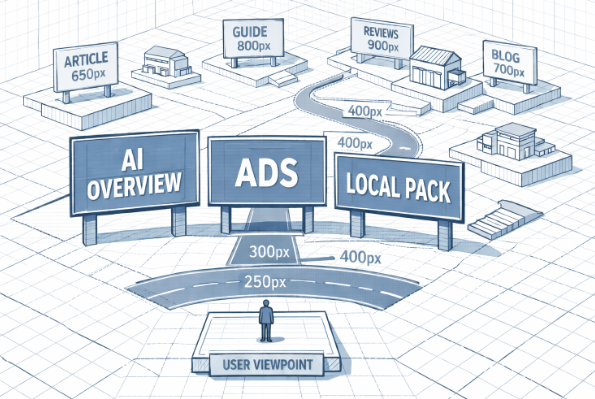
Today, ranking first might mean you're the fourth thing someone sees. Maybe fifth. It depends on how many ads run above you, how long the AI overview is, and whether there's a local pack or featured snippet pushing you down the page.
The question isn't just "where do I rank?" anymore. It's "where am I actually visible on the screen?"
The Three Metrics That Define Visibility Now
Traditional rank position still matters. When we lose a top position, we see it in our traffic numbers. But it's no longer the complete picture. You need to track three things:
Traditional rank position: Your numerical placement in organic results
Pixel position: How many pixels from the top of the page does your result appears
AI citations: Whether and where you're referenced in AI-generated answers
Each metric tells you something different about your visibility. Traditional rank tells you how search engines value your content. Pixel position tells you if users will actually see it. AI citations tell you if you're making it into the new way people search.
Why Pixel Position Matters More Than Rank
A restaurant can rearrange its layout to make shopping more efficient or to encourage customers to browse longer. Search engines do the same thing, but they constantly change their layouts. They test new features, add AI overviews, insert more ads, and shift elements around based on the query.
You can rank first and still be below the fold. We've seen this happen repeatedly. A site holds the #1 organic position, but users have to scroll past three ads, an AI overview, and a local pack to reach it. In practical terms, that's not a #1 position at all.
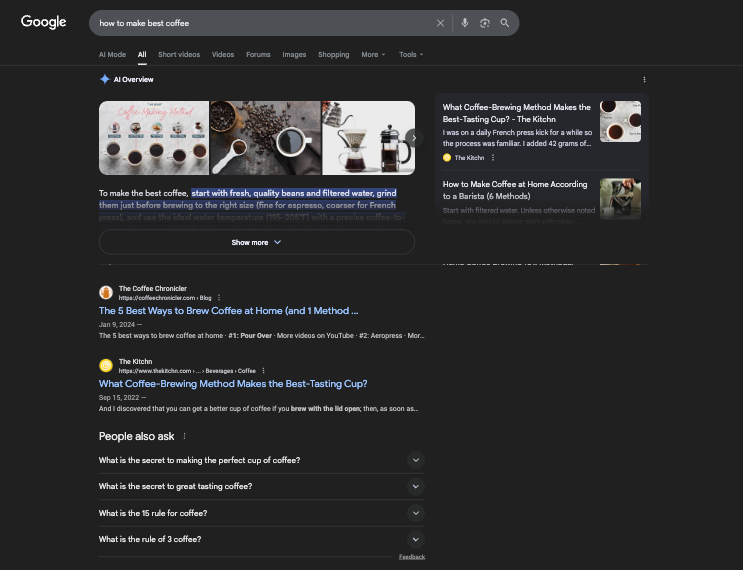
Pixel position tracking solves this problem. Instead of just knowing your rank number, you know exactly how many pixels down the page your result appears. You can measure this in real-time, for any location, and compare it across different queries.
The data shows what you'd expect: pixel position correlates strongly with click-through rates. A result at pixel 800 performs differently from the same result at pixel 1600, regardless of whether both are technically ranked #1.
This matters for locations and languages too. The same query in different cities can produce different layouts. Add multiple languages into the mix, and you're tracking dozens of variations for a single keyword. Real-time pixel position data lets you see exactly what users see in each scenario.
The Technical Reality of Real-Time Tracking
All position tracking needs to happen in real-time because search results change constantly. Historical data becomes outdated quickly, sometimes within hours.
Search engines test new layouts weekly. They introduce features, pull them back, test variations, and iterate based on user behavior. An AI overview might appear for a query on Monday, disappear on Tuesday, and return in a different format on Wednesday.
This creates a challenge for anyone trying to maintain accurate data. You can't scrape once a day and call it current. You can't cache results and assume they'll stay valid. Every query needs fresh data because the landscape is constantly evolving.
The scale compounds the difficulty. Tracking a single keyword for a single location is straightforward. Tracking thousands of keywords across multiple locations, languages, and devices requires infrastructure that can handle constant, high-volume requests while adapting to layout changes in near real-time.
AI Citations: The New Ranking Frontier
More users are moving from traditional search to chat interfaces. Instead of clicking through results, they're getting answers directly. This shift makes AI citations critical.
Being cited in an AI-generated answer is the new visibility metric. It's not enough to rank well in traditional search if users never see the search results page. You need to appear in the AI's response.
We're seeing more requests to track citations across various AI engines. Users want to know: Am I being mentioned? Where in the response? How often? For which queries?
The challenge is that each AI system works differently. ChatGPT structures its responses one way, Perplexity does it another, and search-integrated AI overviews follow their own patterns. Tracking citation position across all these systems requires monitoring multiple interfaces simultaneously.
This is where rank tracking splits into two worlds. Traditional search ranking still matters for users who browse results. AI citation tracking matters for users who want direct answers. Most businesses need to track both because their audience uses both approaches.
What Search Engines Are Optimizing For
Search engines operate on feedback loops. They test changes, measure user behavior, adapt based on the data, and repeat. This isn't a careful, deliberate process anymore. It's constant experimentation at scale.
AI has accelerated this cycle. What used to change monthly now changes weekly or daily. New features appear, perform well or poorly, and either stick around or disappear. The whole system feels algorithmic rather than human-directed, like a massive A/B testing engine running continuously.
This makes prediction difficult. We can see current patterns, but projecting what comes next is speculation. The industry won't stabilize soon because every major player is still exploring, still testing, still competing for position in the AI race.
The practical impact: if you're tracking rankings or building tools that depend on search result structure, you're constantly adapting. Layout changes break parsers. New features require new data models. What worked last month might not work today.
The SEO Migration to AI
SEO is moving from search engines to chatbots. That's the direction we're seeing. More queries go to AI interfaces, fewer to traditional search pages. This shift won't complete overnight, but the trend is clear.
This changes what "ranking" means. In traditional search, ranking is a position in a list. In AI responses, "ranking" might mean being the primary source cited, or being mentioned at all, or being linked in the references. The concept needs redefinition.
For businesses, this means tracking visibility across both paradigms. You still need traditional rank data because search isn't going away immediately. But you also need AI citation data because that's where the trajectory points.
The challenge for rank-tracking tools is supporting both modes without overwhelming the data. Users need to know: "Where am I visible?" The answer now requires multiple data points across different systems.
What This Means for Your Strategy
If you're still optimizing solely for traditional rank positions, you're measuring an incomplete picture. Here's what to track instead:
- Traditional rank position: Still matters for understanding search engine valuation and for queries that haven't shifted to AI answers yet
- Pixel position: Shows actual visibility, accounting for all the elements pushing you down the page.
- AI citations: Indicates visibility in the growing segment of users who skip search results entirely.
Each metric serves a different strategic purpose. Traditional rank guides your SEO fundamentals. Pixel position tells you if your visibility matches your rank. AI citations show if you're prepared for where search is heading.
The Infrastructure Challenge
Building rank tracking infrastructure at scale isn't viable for most organizations anymore. It might have been possible a few years ago with simpler search layouts and slower change cycles. Today, the technical and operational overhead make it impractical.
The infrastructure needs to handle:
- Real-time data collection across hundreds of search variations
- Constant adaptation to layout changes
- Parsing complex, dynamic content, including AI-generated elements
- Scaling to thousands of queries per client
- Maintaining accuracy across different locations, languages, and devices
Each of these challenges alone is solvable. Combined at scale, they require dedicated teams, significant engineering resources, and continuous maintenance. For most businesses, it's more cost-effective to use specialized tools like a SERP tracking API than to build and maintain the infrastructure internally.
Where We're Headed
The rank tracking industry won't stabilize in 2026. AI companies are still exploring how to present information, search engines are still testing layouts, and users are still adapting their behavior. We're in a transition period that will continue.
What seems clear: the definition of "ranking well" is expanding. It now includes traditional position, actual visibility (pixel position), and presence in AI-generated content. Tracking one metric without the others leaves you blind to parts of your actual visibility.
The shift from search engines to chatbots will continue. This doesn't mean traditional search disappears, but it does mean the weight shifts. More queries get answered by AI, and fewer clicks go through to websites. Businesses need visibility in both channels.
For anyone serious about search visibility, the strategy is straightforward: track all three metrics, understand what each tells you, and optimize for both traditional search and AI citations. The tools and techniques that worked five years ago aren't sufficient anymore. Visibility requires a more complete view.
The technical challenges of tracking these metrics at scale aren't getting easier. They're getting harder as search engines and AI systems evolve faster. This makes specialized tracking tools more valuable, not less.
If you're still making decisions based solely on traditional rank positions, you're working with incomplete data. The question isn't whether to adapt to these new metrics; it's how quickly you can implement tracking that covers the full picture of your visibility.
Next Steps
Ready to implement comprehensive rank tracking? Here are three paths forward:
Build a custom rank tracker: Use the SERP Tracking API to create your own white-label solution that monitors traditional rankings, pixel positions, and AI citations across multiple search engines.
Track AI citation performance: Learn how to scrape and monitor AI Overviews to understand when your content appears in AI-generated answers and track citation frequency across different queries.
Monitor competitor visibility: Discover the Web Search API alternatives available for tracking how competitor positioning in both organic and paid results affects your visibility across key search terms.