 Google Local Services API
 Google Travel Explore API
 Baidu Search API
 Bing Search API
 DuckDuckGo Search API
 eBay Search API
 Naver Search API
 OpenTable Reviews API
 The Home Depot Search API
 Tripadvisor Search API
 Walmart Search API
 Ruby
Ruby
 Golang
 .Net
.Net
 MCP
MCP
 C++
C++

If you’re building products that rely on web search — AI apps, research tools, lead collectors, price trackers, or internal dashboards — you’ve probably heard of SerpApi. It’s a popular choice because it turns messy search engine pages into clean, structured data with zero scraping pain.
That said, SerpApi isn’t the only option. You may have heard some of the Search API alternatives. In this article, we’ll walk through the most popular SerpApi alternatives as a Web Search API:
- Brave Search API
- Exa
- Tavily
- Firecrawl
- Serperdev and more
We’ll break down what each tool is good at, who it’s best for, and when you might choose it over SerpApi.

Why do many companies choose SerpApi?
Before jumping into alternatives, here’s why developers typically use SerpApi:
- Complete Search Engine APIs: We cover more than 100 APIs that give you programmatic access to Google, Bing, DuckDuckGo, etc.
- Real-time results: We always perform live scraping for you; it's not coming from a database.
- Structured JSON responses (no HTML parsing). No more DIY that forces you to spend time and resources on keeping up to date with the latest layout. Use a simple API, and you are done.
- Enterprise-ready: We're SOC2 Type II certified and can handle a high volume of searches for your team.
- We've been in business since 2017. So, we faced many issues that our competitor hasn't. We're focusing on scraping search engine results, not just any websites. That keeps us focused on our vision and our daily work.
- Location, language, device, and other parameters to narrow your search to what you need.
- Use cases: AI agents, SEO tools, market research, price monitoring, and lead collection.
If all of that sounds good to you. You can register for free at serpapi.com
Best Web Search API Options
Now, let's see some options for web search API:
1. SerpApi
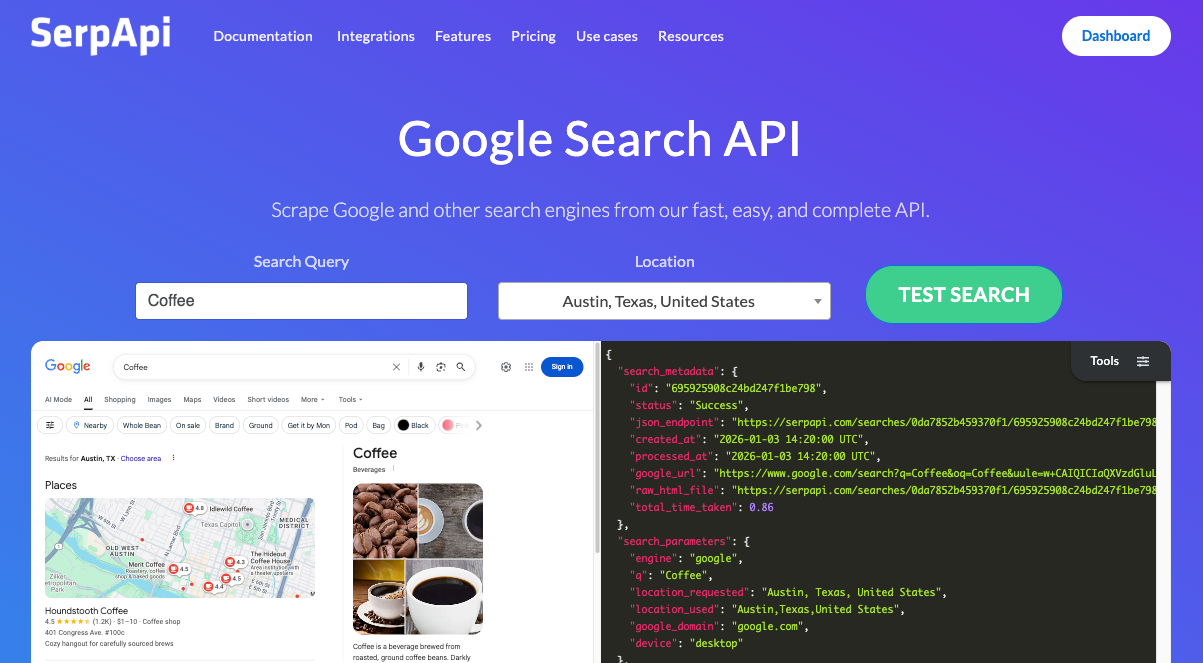
SerpApi provides public search results data from various search engines in a structured JSON format. We currently cover more than 100+ APIs.
We don't manipulate the data in any way; we leave it to the developers to decide what to do with it, including providing responses to AI tools for various use cases. No hidden algorithm.
Pros
- Unedited real-time results
- Support 100+ APIs, you can pick depending on your application needs
- Simple API through a single HTTP GET request
- Flexible use cases
Cons
- Depending on the volume, SerpApi is not the cheapest option, as it prioritizes result quality.
2. Brave Search API
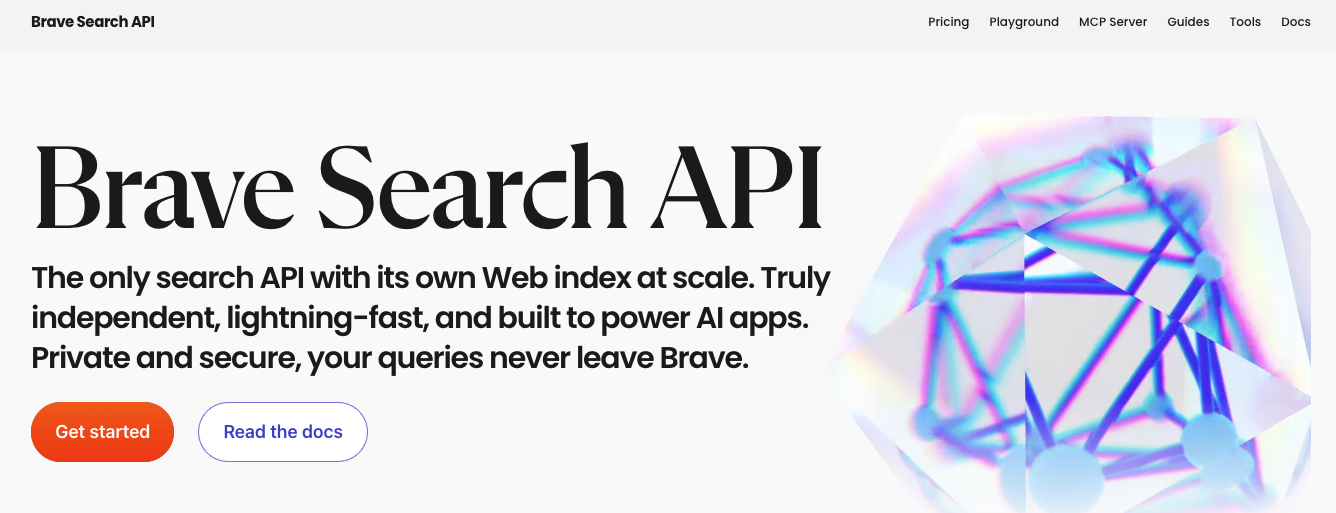
Brave Search API gives you access to Brave’s own search index, not Google or Bing results.
Pros
- Uses Brave’s independent search index
- Want an alternative to Google/Bing dependency
Cons
- Limited to only Brave's own algorithm and database
- Not a drop-in replacement for Google SERP and other engines scraping
- Not ideal for product or business research
- Less SEO-specific data (ads, rich snippets, local packs, etc.)
When to choose Brave over SerpApi
👉 When your apps need generic knowledge from search results and want to be independent from Google, Bing, or other search engines.
Read more Brave Search API vs SerpApi
3. Exa
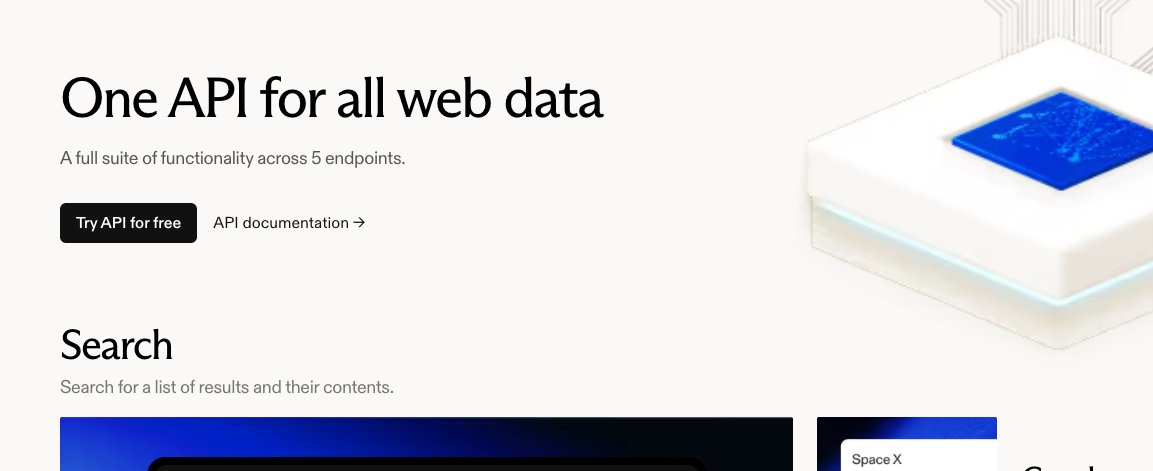
Instead of returning raw SERP-like results, Exa focuses on semantic search or "natural language search query".
Pros
- Uses Exa's own search index. It can be faster as the source is coming from a database
Cons
- Not designed to perform live scraping on search engines
- Limited to their own algorithm and database
- Not ideal for product or business research
- Less useful for SEO monitoring, rank tracking, or ad data
When to choose Exa over SerpApi
👉 When you’re building apps that don't really need real-time or raw data from a search engine.
Read more Exa.ai vs SerpApi👉
4. Tavily
Tavily takes a different approach. It aggregates content from multiple web sources and processes it on its side before returning the response to the customer.
Pros
- Aggregated search results
Cons
- Returned results are based on their algorithm
- Summarized search responses might not be what people want in many cases
- Not ideal for product research or SEO tooling that needs real-time data.

When to choose Tavily over SerpApi
👉 When your app doesn't need the exact live data results from search engines, and you're fine using Tavily's algorithm for the returned results.
5. Firecrawl
Firecrawl is a website content scraper. You point it at a URL, techcrunch.com/article/some-news and it returns clean, LLM-ready markdown of that article.
SerpApi is a search engine scraper. You query it with "best CRM software," and it returns what Google (and other top search engines) shows for that query: the top 10 organic results, the paid ads, the featured snippet, the "People Also Ask" box, and the local map pack.
Pros:
Return the full content of a link
Cons:
- You have to supply the individual link/URL
- You can't scrape specific search engine results
Read more: SerpApi VS Firecrawl, which one to use?
6. Serperdev
Serperdev is closer to SerpApi in how they return raw search engine results.
Please read our blog post on SerpApi vs Serper:
 Hilman Ramadhan
When to choose Serper over SerpApi
👉 When you want something closer to traditional SERP scraping with simpler needs or lighter usage.
Final Thoughts
Every web search API has its place. Tools like Brave, Exa, Tavily, or others shine for specific use cases.
If your product depends on reliable, production-grade SERP data at scale across search, shopping, maps, reviews, and more, long-term stability matters. As you move from prototypes to real users, mature infrastructure, consistent parsers, strong uptime, and predictable data formats become critical.
This is where SerpApi stands out. It’s more than a web search API. It’s a battle-tested web data platform teams trust to power AI features, SEO tools, lead generation, price monitoring, and product research.
If you’re evaluating options, the best move is to try a few APIs side by side. But when reliability, coverage, and developer experience start to matter more than experiments, you’ll likely want something built for the long haul.