 Google Local Services API
 Google Travel Explore API
 Baidu Search API
 Bing Search API
 DuckDuckGo Search API
 eBay Search API
 Naver Search API
 The Home Depot Search API
 Tripadvisor Search API
 Walmart Search API
 Ruby
Ruby
 Golang
 .Net
.Net
 C++
C++

Search engine results are no longer just a list of links. Many search engines like Google and Bing surface AI generated answers directly in the results page - in summaries, conversational responses, and synthesized insights that sit above or inside traditional SERP features. For developers and data teams, this raises an interesting question: How can you programmatically collect and analyze these AI answers the same way you do classic SERP data?
With SerpApi you can scrape these generated answers without needing to write brittle scraping logic.
In this post we'll walk through how AI generated answers appear across major search engines and how SerpApi exposes them in structured JSON.
Why scrape AI generated responses?
AI generated answers have quickly become the first thing users often see. Scraping them enables:
- Generative engine optimization (GEO) & content research - Understand what content AI models consider authoritative and trustworthy, and track how your pages appear in AI-generated answers.
- Search experience monitoring - Track how AI summaries describe your brand or product.
- Competitive analysis - See which competitors are mentioned or cited.
- LLM grounding - Compare AI answers across engines for factual drift.
- Product intelligence - Detect changes in how queries are answered over time.
Let's dive into where we can find these AI responses.
Google: AI Mode, AI Overviews, and AI in People Also Ask
Google AI Mode (Conversational Search)
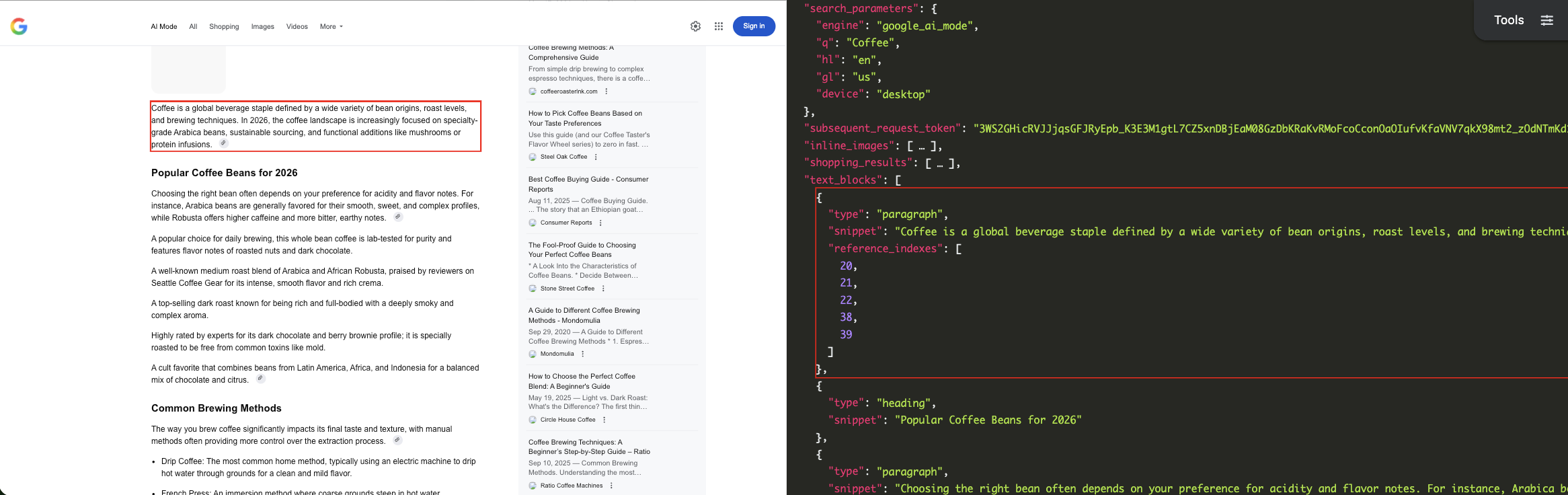
Google AI Mode introduces a chat‑like search experience, where the response is generated dynamically rather than assembled from classic SERP blocks.
With SerpApi, you can capture these responses in structured form with our Google AI Mode API:
- The full AI response text
- Follow up questions at the end of the answer
- All the references
- Shopping results
Try out an example here:
 SerpApi
Here is what the response looks like:
Google AI Overviews
Google AI Overviews appear at the top of the SERP results as a synthesized AI generated answer with citations.
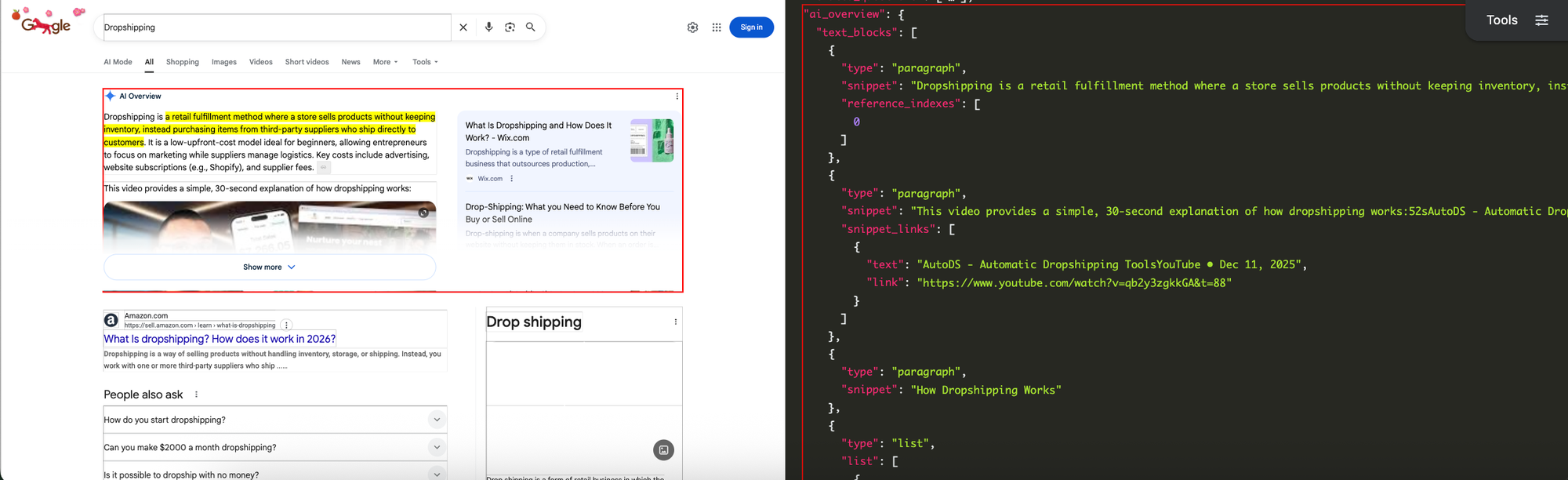
With SerpApi’s Google Search API, AI Overviews are returned as a dedicated JSON object, typically including:
- The generated summary text
- Referenced sources / citations
- Highlighted concepts
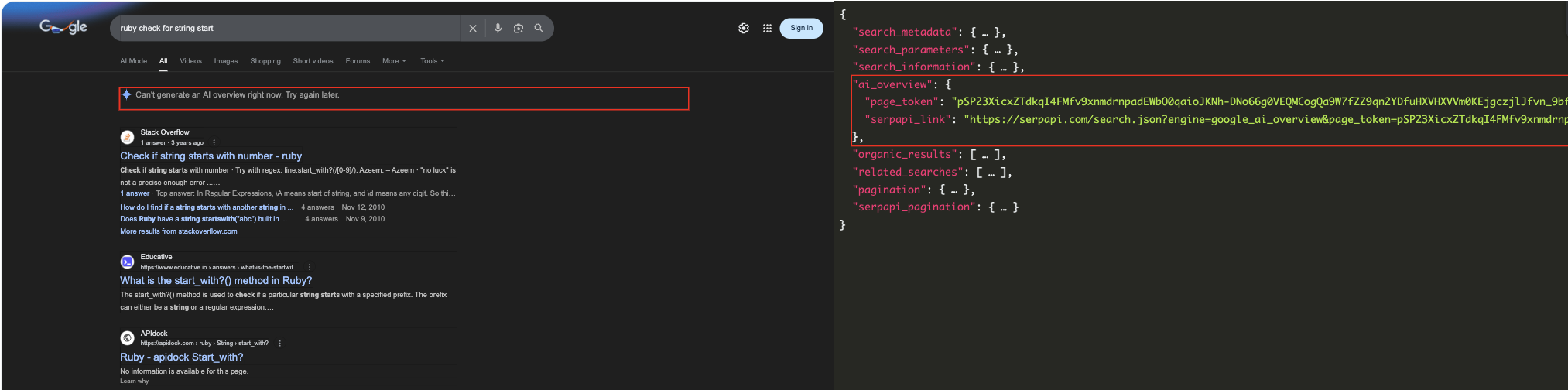
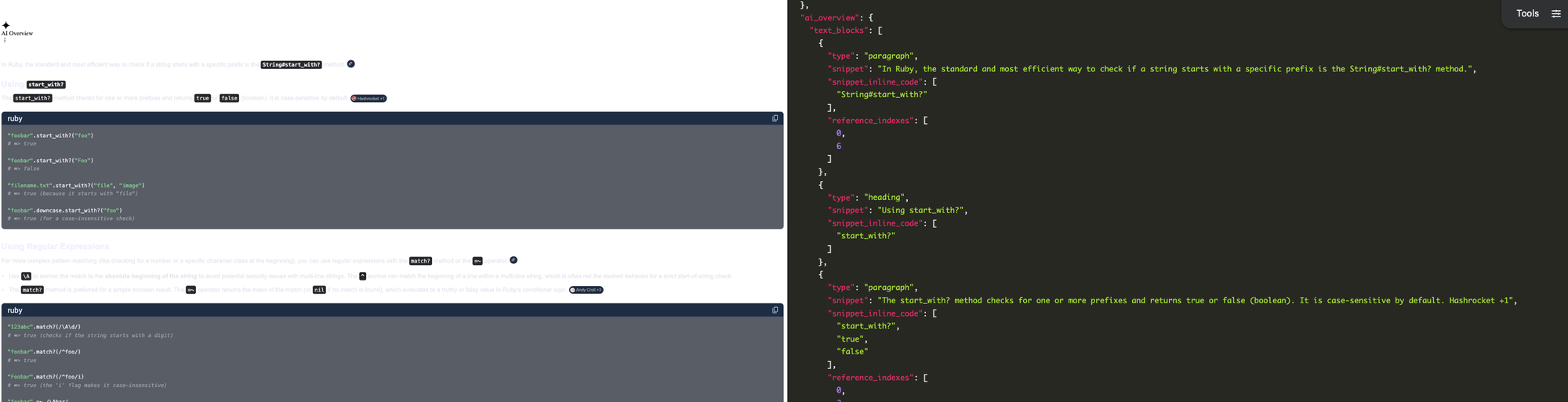
page_token in the ai_overview object. When this happens, you can send an additional request to the AI Overview API to retrieve the full AI Overview.
You can do this using the
page_token or by simply sending a GET request to the serpapi_link in the ai_overview object in the Google Search API response. The page_token is only valid for one minute after the initial request, so we recommend querying for the AI overview immediately after your initial search.This allows you to extract the AI generated answer without parsing HTML or executing JavaScript.
Try out an example here:
 SerpApi
Here is what the response looks like when the ai_overview content is included:
Here is what the response looks like when the a page_token is returned instead:
After a request to the AI overview API with that page_token we get:
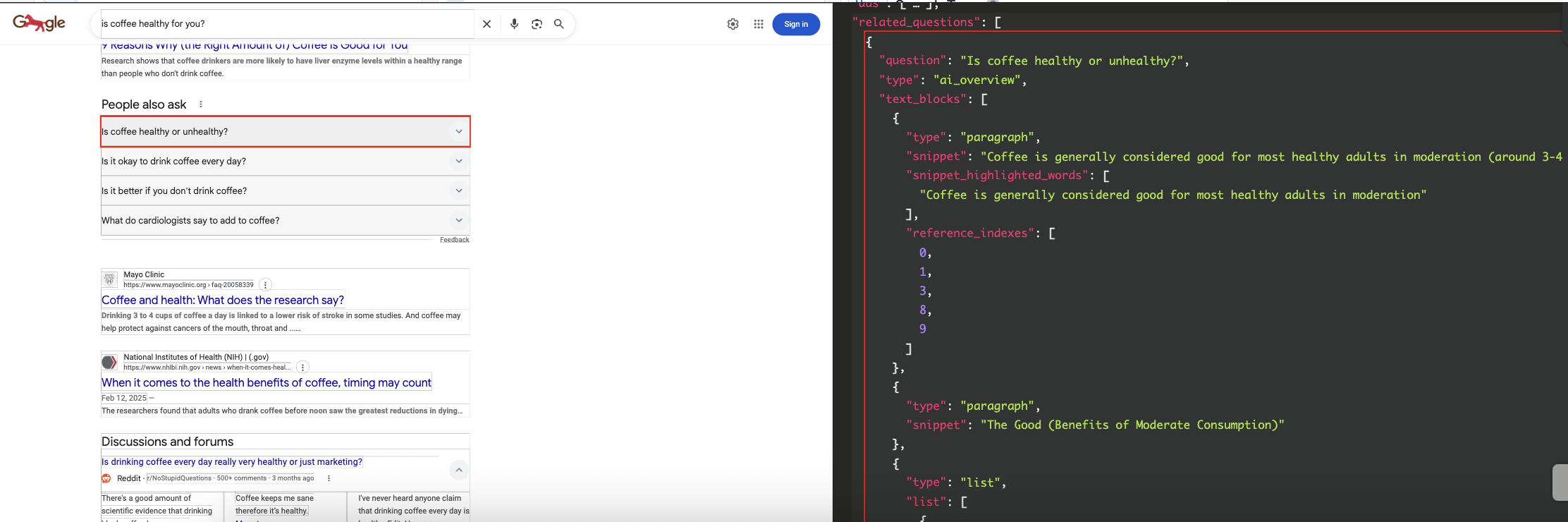
AI Answers in “People Also Ask” (PAA)
The People Also Ask section has evolved from expandable snippets with human written answers into AI‑style synthesized answers for many queries.
Using SerpApi, you can get each PAA question and answer using our Google Search API, which includes:
- The associated question
- The generated answer text
- Source references (when available)
Try out an example here:
 SerpApi
Here is what the response looks like:
Bing Copilot Answers
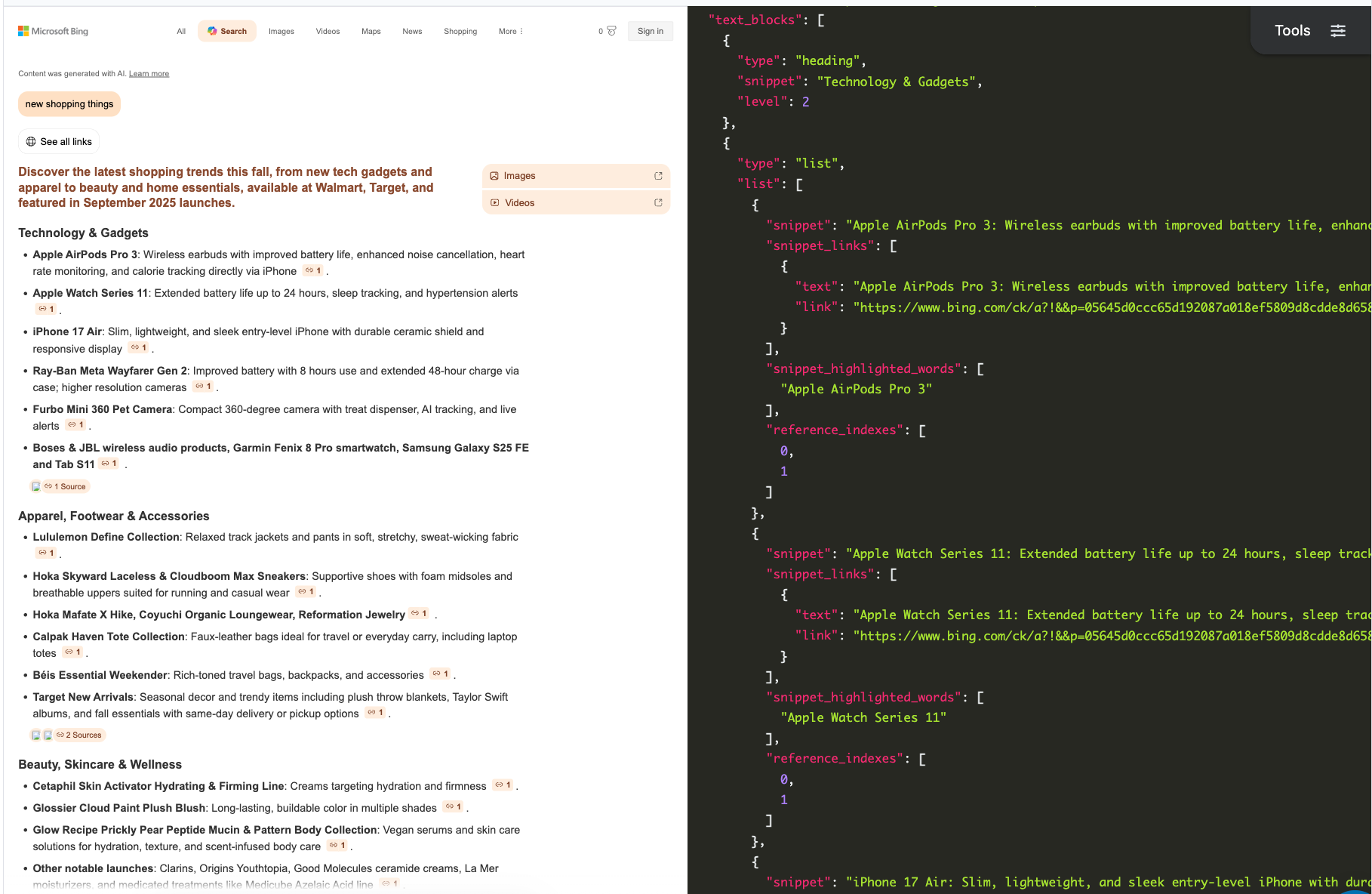
Microsoft Bing has a Copilot page where you can get ask questions in a chat‑like search experience.
With SerpApi’s Bing Copilot API, Copilot responses are exposed as structured fields rather than embedded UI components.
You can extract the following from the Copilot generated answer:
- Text and lists
- Links wherever they appear in the answer
- Reference indexes
- Related follow‑up prompts
Try out an example here:
 SerpApi
Here is what the response looks like:
DuckDuckGo Search Assist API
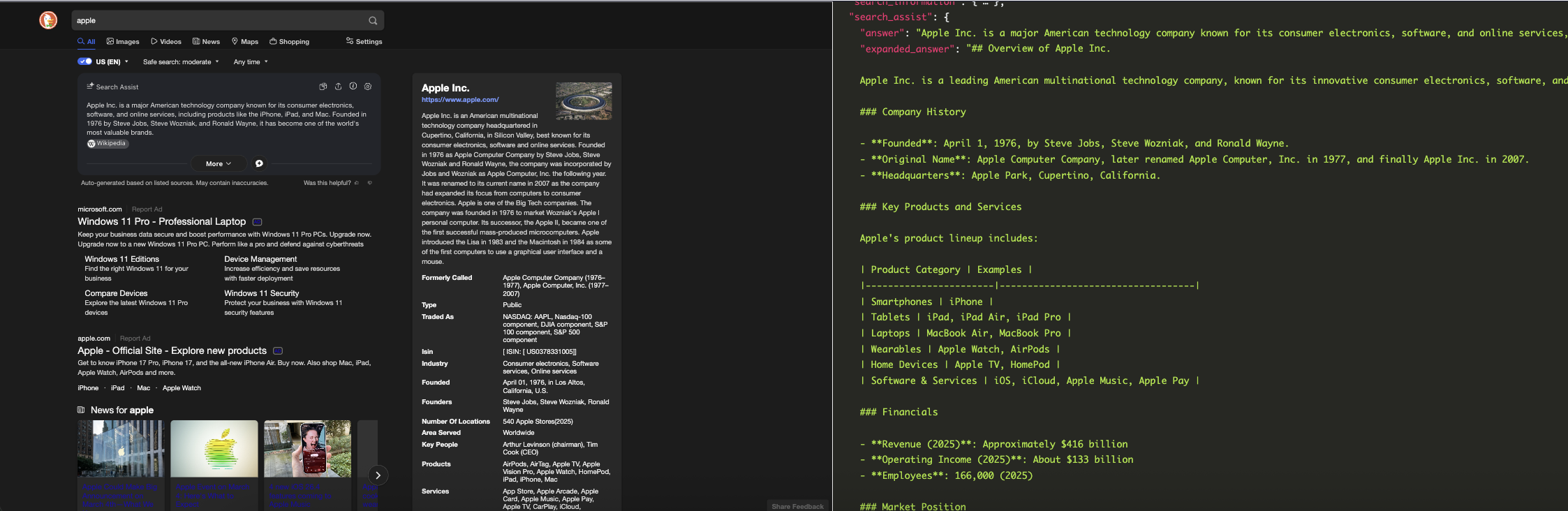
DuckDuckGo exposes AI assisted summaries and responses through its Search Assist experience.
With SerpApi’s DuckDuckGo Search Assist API, by setting the search_assist parameter to true, you can programmatically retrieve:
- AI generated instant answers
- Referenced sources / citations
answer, expanded_answer, sources, titles, abstracts, domains, urls, organic_word_ngrams, and organic_wiki_entities.DuckDuckGo is the only engine to include organic word n-grams (sequences of n consecutive words) in their AI assisted summaries. These may be used to structure and optimize content based on actual search-driven data. They allow you to move beyond single-keyword targeting to understand user intent, phrase patterns, and topical depth.
Try out an example here:
 SerpApi
Here is what the response looks like:
Naver AI Briefing
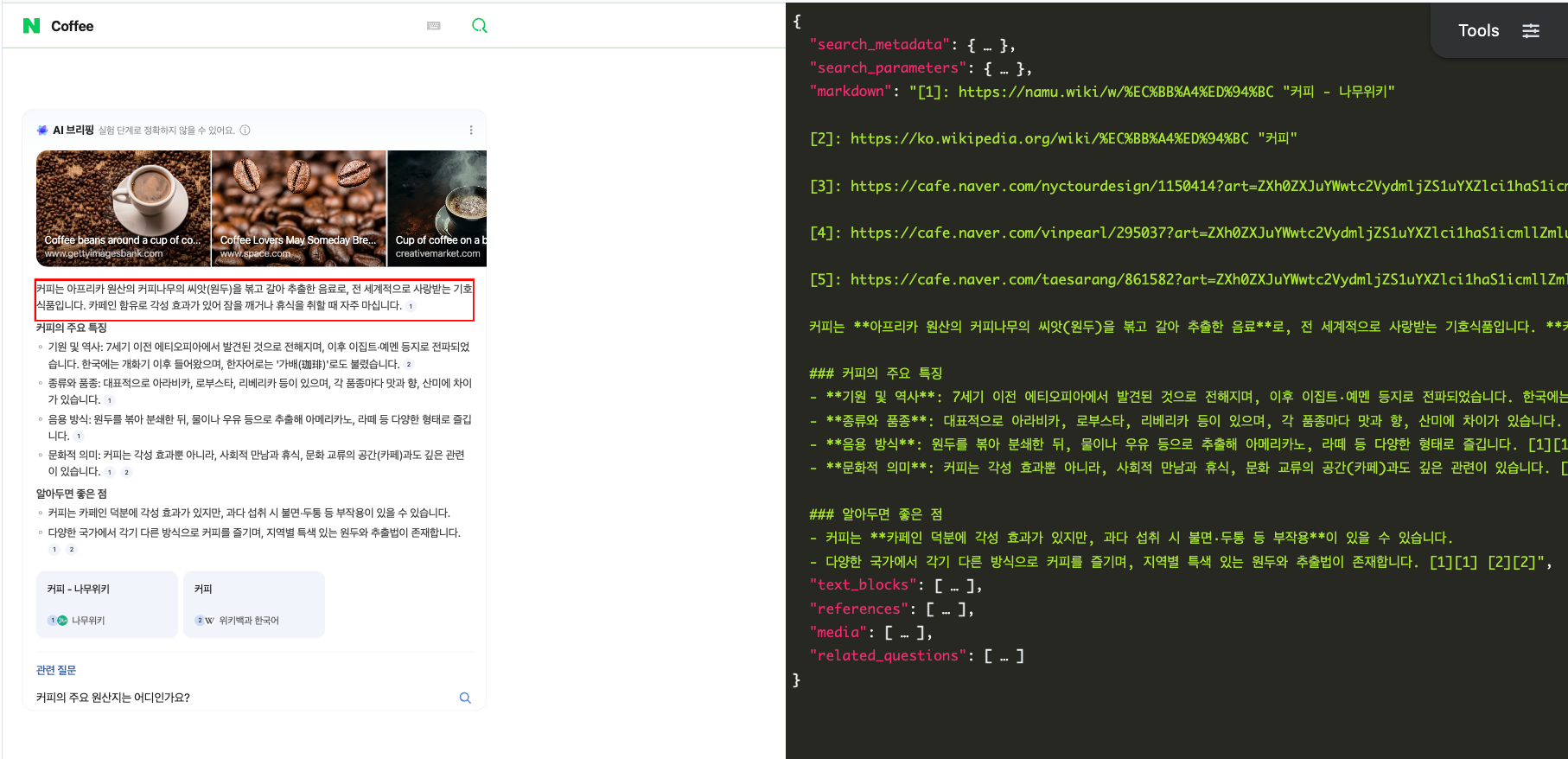
Naver, the dominant search engine in South Korea, has rolled out its own AI Briefing feature, tailored to local content and language preferences.
SerpApi supports Naver search results and surfaces the AI generated answer in structured JSON with the Naver AI Overview API, including:
- AI generated answer (in markdown or broken down by paragraphs)
- Linked sources from Naver properties and external sites
- Reference indexes
- Any displayed media
Try out an example here:
 SerpApi
Here is what the response looks like:
Why Use SerpApi?
SerpApi streamlines the process of web-scraping. SerpApi manages the intricacies of scraping and returns structured JSON results. This allows you to save time and effort by avoiding the need to build your own scrapers or rely on other web scraping tools.
We do all the work to maintain all of our parsers and adapt them to respond to changes on search engines. This is important, as search engines are constantly experimenting with new layouts, new elements, and other changes. By taking care of this for you on our side, we eliminate a lot of time and complexity from your workflow.
Conclusion
As search continues to evolve from links to overviews and AI generated answers, having structured access to AI generated responses gives you a critical edge.
I hope this post enabled you in understanding how AI generated answers appear across major search engines and how you can use SerpApi to get them in structured JSON. Feel free to reach out to us at contact@serpapi.com for any questions.
Relevant Links
Documentation
Related Posts
 Emirhan Akdeniz
 Hilman Ramadhan
 James Collins